A Small World Cup Unblocked
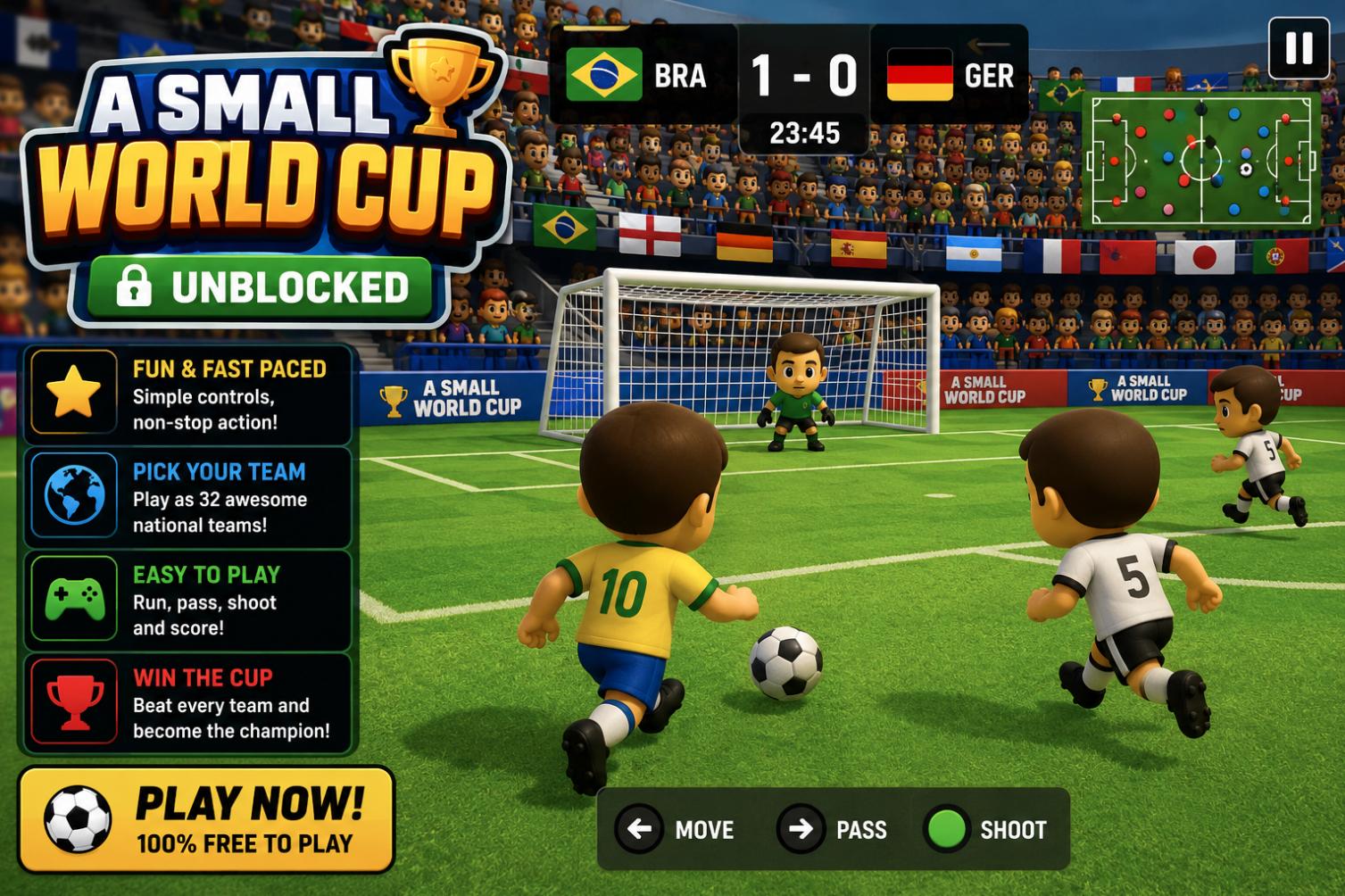
A Small World Cup is the browser football game that turned rag-doll physics into a comedic accident engine and gathered a substantial audience doing it. The premise is straightforward: two flopping players wrapped in what look like plastic Zorb balls attempt to move a football into a goal. The players are controlled by pressing one button — usually the space bar or a click — that swings them upward in whatever direction their body happens to be facing at that moment. Coordination is minimal. Comedy is inevitable. The game has become a fixture of the casual browser space, both as a solo distraction and as a shared-laptop-with-a-friend party game.
What makes the game specifically funny
The physics in A Small World Cup are deliberately loose. Players do not run; they flop. Kicks are not aimed; they are triggered, and the ball goes where the flailing limb happens to intersect it. Goals are as often accidental as they are strategic — a rebound off the ceiling, a lucky trajectory from a player who was mid-fall — and the game leans into that unpredictability rather than smoothing it out.
The visual style supports the tone. The players are stylised, brightly coloured, and clearly not attempting to look like real footballers. The stadium is stylised in the same direction. The audio — a mix of thumps, whistles, and cheer effects — sells the atmosphere without taking the sport seriously.
The specific combination of rag-doll physics and one-button control is what makes the game feel novel. Physical humour has been in browser games for years; A Small World Cup’s specific hook is that the humour is produced by the interaction of a serious-looking constraint (a football match) with a comical mechanical premise (pressing one button to flail).
How the modes actually play
The game supports single-player play against an AI opponent and two-player play on a shared keyboard. Both modes work well; the game’s design shines in the two-player mode, where the shared physical space of laughing at what just happened is a substantial part of the experience.
| Mode | Control setup | Best for |
|---|---|---|
| Single-player vs AI | Space bar or click | Casual play, five-minute sessions, learning the physics |
| Two-player local | Split keyboard controls | Shared laptop, party moments, escalating rivalries |
| Tournament / cup progression | Same as single-player | Players who want a structured run against progressive AI difficulty |
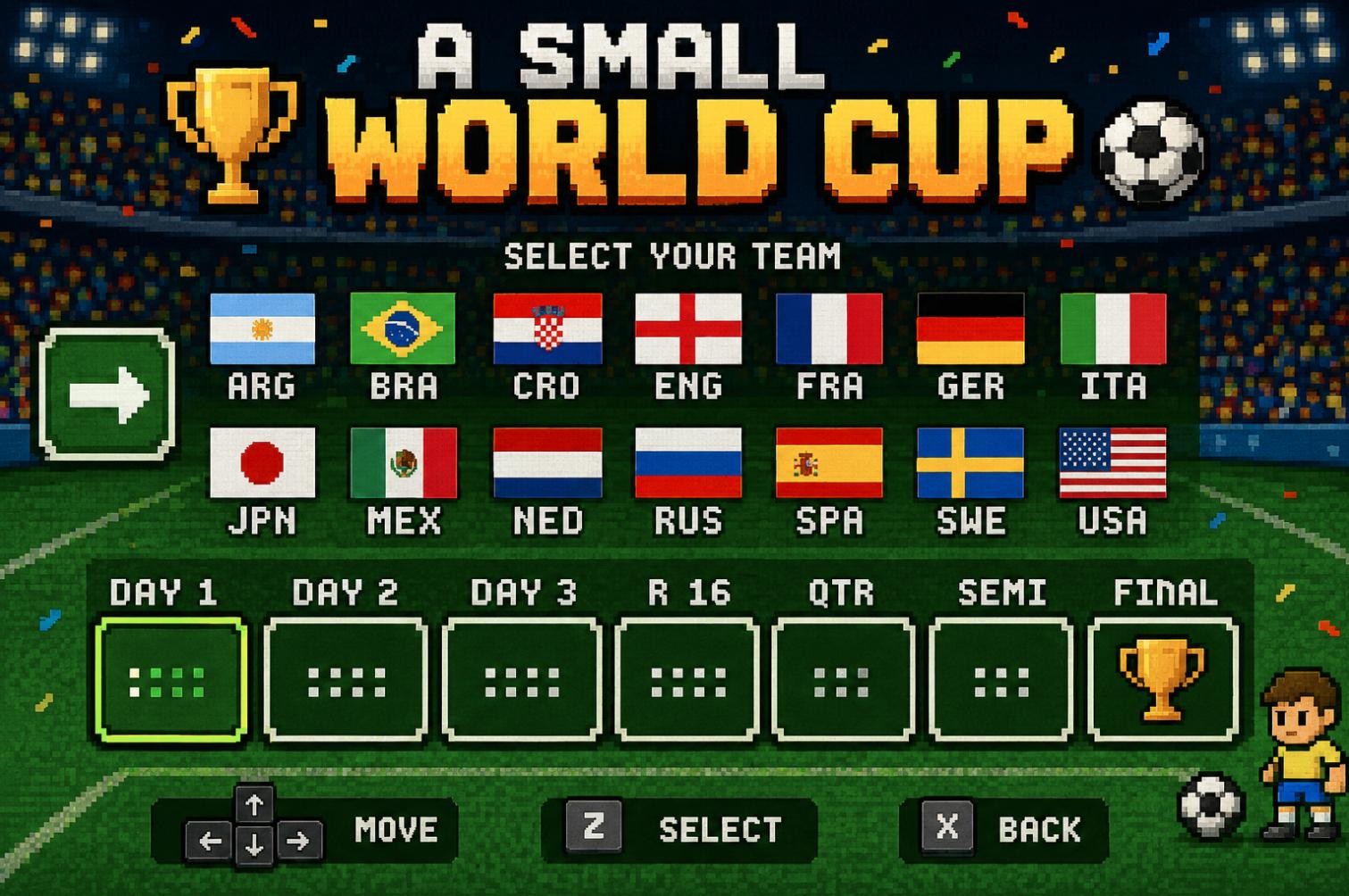
Tournament mode is worth mentioning specifically. The game supports a bracket format that lets players work through a series of opponents at increasing difficulty. Reaching the final and winning the cup is a real achievement — not because the game is technically hard, but because the physics remain chaotic enough that even a favoured player can lose to a lucky bounce.
Playing better without breaking the joke
Serious players eventually discover that the game rewards specific habits, without ever becoming a game where technical skill dominates over chance.
Positioning matters more than the buttons. The single button provides the swing; the effective input is choosing when to be near the ball. Standing between the ball and your own goal is more valuable than trying to actively defend; being between the ball and the opponent’s goal is more valuable than trying to actively score.
Rhythmic button presses beat panicked spamming. When the ball is bouncing across the field, a steady rhythm of presses keeps the player in the action; frantic spamming produces trajectories that are as likely to send the ball into your own goal as into the opponent’s.
Reading the ceiling angles matters. Many goals in A Small World Cup come off ceiling rebounds. Players who notice the ceiling geometry and time their inputs to send the ball toward specific angles score more consistently than players who focus only on horizontal play.
Accepting the chaos is the fastest path to enjoyment. Players who fight the physics — trying to control every trajectory, blame every loss on unfair bounces — end up frustrated. Players who lean into the specific mode of comedy the game is offering have a better time.
Where the game fits in the casual browser space
A Small World Cup sits inside a specific tradition of physics-based one-button games. Its cousins include QWOP (the canonical example of intentionally awkward control), Ragdoll Achievement, various football and sports parodies that use rag-doll physics, and the wider category of “silly physics” that emerged partly as a reaction against increasingly serious sports simulations.
The specific niche the game occupies is casual multiplayer physics comedy. Games in that niche have become more visible in recent years — Human Fall Flat, Gang Beasts, Fall Guys, and the wider party-physics wave — but A Small World Cup delivers a compressed version of the format that fits in a browser tab and requires no download, no account, and no friend on the other end of an internet connection.
The unblocked-browser experience
The game is available across most unblocked-games portals and runs cleanly on modest hardware. Loading is fast; the game itself is not visually demanding; input latency is not a significant issue at the physics speeds the game targets. On a mid-range Chromebook, the experience is close to what the developer intended.
Well-maintained portals deliver the game without interstitial advertising, without prompts to install anything, and without account requirements. Weaker portals introduce ads between matches or prompts that break the specific casual-comedy flow the game depends on. As with other casual browser games in this ecosystem, choosing a decent portal makes a real difference to the experience.
For anyone with a physical keyboard nearby and a willing friend, the two-player mode is the highlight of the game and worth the small investment of coordinating a shared session.
FAQ
Is A Small World Cup free?
Yes. The game is free to play through browser portals. The developer (Rujik the Comatose) has kept the game accessible for years.
Can I play against a friend online?
The classic version is designed for local two-player on a shared keyboard. Online multiplayer is not the default mode; some ports may add rudimentary online features, but the shared-laptop experience is where the game shines.
What controls does two-player use?
Typically one player uses a keyboard shortcut on the left side (Q or W or Left Shift, depending on the port) and the other uses one on the right side (M or the right arrow). The specific mapping varies by port.
Is there a tournament or cup progression?
Yes. The game supports a cup mode where the player faces increasingly difficult opponents in a bracket format. Winning the final is a legitimate accomplishment given the physics.
Does the game work on mobile?
The browser version generally works on mobile but the touch controls are awkward, and the two-player mode is not practical on a phone. Desktop or laptop is the intended experience.
The wider point about physics comedy games
A Small World Cup is a specific example of a general observation about how physical humour translates into interactive form. Watching someone else fall over is funny in ways that watching yourself fall over is not — the specific mechanic of controlling a rag-doll body inverts that dynamic and makes personal failure the source of amusement. The best games in this space understand that. They design the physics loose enough that failure is common; they make the failure visually specific enough to be entertaining; and they keep the stakes low enough that failure does not feel like real loss.
Games that get this balance wrong either produce too little failure to be funny or too much punitive failure to be enjoyable. A Small World Cup hits the ratio well. Its cousins in the browser space that have not endured usually failed one of the two calibrations.
Practical settings for a group session
For anyone bringing the game to a group or party setting, a small set of practical notes helps.
Keep sessions short. Best-of-three or best-of-five is the right structure. Extending sessions until one player wins produces boredom rather than escalating fun.
Rotate players. A shared laptop can easily support four or six players cycling through in matches; the spectators are laughing as much as the players.
Play with sound on. The audio adds meaningfully to the atmosphere and the comedy.
Do not take losses personally. This is a physics-comedy game; the humour is that skill matters less than positioning and rhythm, and even those matter less than the specific bounces the physics produces on a given match.
A short close
A Small World Cup is a small, joyful game that does one thing well and does not try to do more. The rag-doll physics are the design; the single-button control is the design; the comedy of the intersection is the payoff. Playing it seriously is fine. Playing it with a friend is better. Approaching it looking for depth and demanding it is a category error. What the game offers is a compressed, replayable moment of physical humour that fits into any downtime, and on those terms, it delivers consistently. That is more than most casual browser games do.