Beta Character AI: What the URL Meant and Where It Is Now
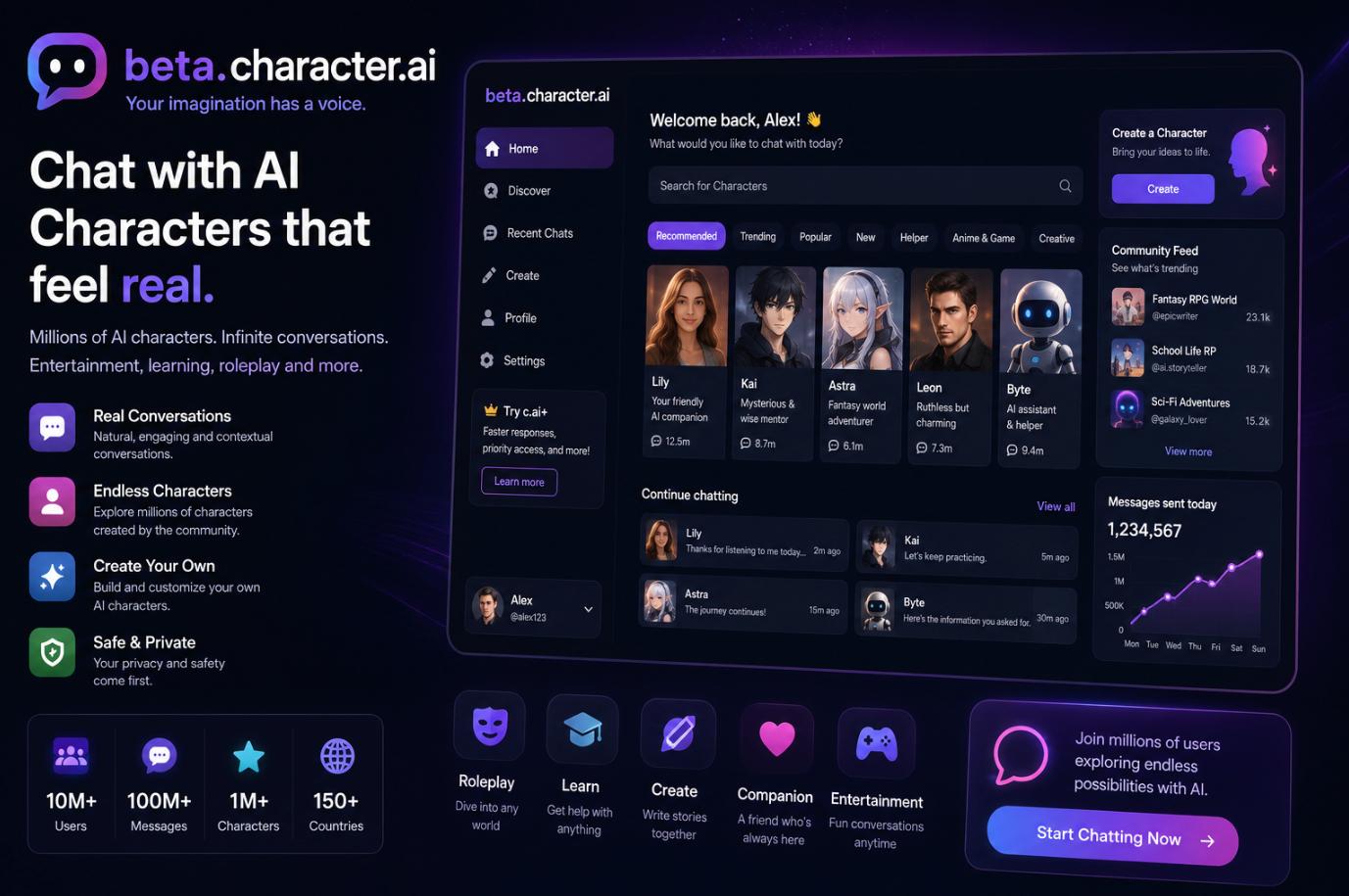
The phrase “beta character AI” carries a specific piece of history. It points to beta.character.ai, the subdomain where Character.AI first opened its platform to the public in late 2022 — a period when the site was, for many users, a first hands-on encounter with a modern large language model that could hold a coherent conversation as a defined character. Three years and several corporate chapters later, the beta label has stuck in the search behaviour of new users even as the product itself has changed substantially.
What people usually want when they type “beta character AI” into a search bar falls into a few clean buckets. This piece walks through each of them, clarifies what the beta actually was, and explains how the modern Character.AI relates to the earlier version most people first heard about.
What “beta character AI” actually refers to
Character.AI, the company, was founded in 2021 by Noam Shazeer and Daniel De Freitas, both former Google engineers with deep backgrounds in the language-model work that eventually produced LaMDA. The company kept a low profile until September 2022, when the platform launched publicly at beta.character.ai. That subdomain is where users chose personas, held conversations, created their own characters, and — in the process — turned the site into one of the fastest-growing consumer AI products of that era, briefly rivalling ChatGPT in engagement time per user.
The “beta” in the URL was a product decision, not a temporary marker. Character.AI stayed on the beta subdomain long enough for it to become the canonical way users referenced the platform. Today, the primary product lives at character.ai without the beta prefix, but the older URL is still what many articles, screenshots, and Reddit threads point to, which is why the phrase persists in searches.
Where the platform sits today
Character.AI in 2026 is a different creature than the 2022 beta was, along several axes.
Ownership and technical direction
In August 2024, Google entered into a licensing deal with Character.AI that saw Noam Shazeer and several senior researchers return to Google DeepMind, while the company itself continued operating as an independent product. That arrangement — a licensing agreement rather than an acquisition — kept regulators away from the transaction while giving Google access to the underlying research team. The consumer platform has continued to operate since.
Model quality and consistency
The models powering Character.AI have improved with each iteration, though the exact underlying architecture is not fully disclosed. Compared to the 2022 beta, characters hold voice more reliably over long conversations, respond more coherently to complex prompts, and handle multi-character scenarios with greater fidelity. The most obvious win over time has been context window: early beta conversations degraded within a few dozen turns; modern ones hold together for much longer.
Content policy shifts
This is where the most user friction has lived. Content moderation on Character.AI tightened noticeably in mid-2023 and again in 2024, prompting a well-documented user exodus toward more permissive platforms — Chai, Crushon, Janitor AI, and a rotating cast of smaller alternatives. Users still searching “beta character AI” occasionally do so hoping to find a version of the platform with the older, more permissive behaviour. That version no longer exists.
Safety and youth-facing changes
In late 2024 and through 2025, Character.AI implemented significant additional safeguards specifically around younger users, following broader public conversation about AI companion apps and adolescent wellbeing. Distinct experiences for minors, harder guardrails on emotionally intense conversations, and clearer escalation paths for concerning content have all been rolled in. These changes are load-bearing for how the product feels in 2026, and they are worth being aware of before evaluating the platform against alternatives.
Why users still search the old beta URL
Several distinct groups continue to type “beta character AI” long after the beta framing was retired.
Returning users. People who first encountered Character.AI at beta.character.ai in 2022 or early 2023 sometimes return years later, use the URL they remember, and end up here trying to figure out where the platform lives now. For this group, the answer is straightforward: character.ai remains the address, and the account they had should still work.
Users seeking older behaviour. A smaller but visible group searches “beta” hoping to find the pre-moderation version of the product. That version does not exist on any current Character.AI URL. Users in this group generally end up either accepting the modern platform’s limits or migrating to a competitor.
Users confused by references. Older articles, YouTube tutorials, and Reddit threads still link to beta.character.ai. New readers encountering those references reasonably assume there is a separate beta product. There is not. The beta subdomain historically redirected, and the current product is what you actually reach.
Users looking for a genuine beta programme. A fourth group is searching for an actual beta-testing programme — early access to new features, insider builds, or a testing panel. Character.AI has run occasional invite-only feature tests, but there is no ongoing publicly enrollable beta programme at the URL these users are searching.
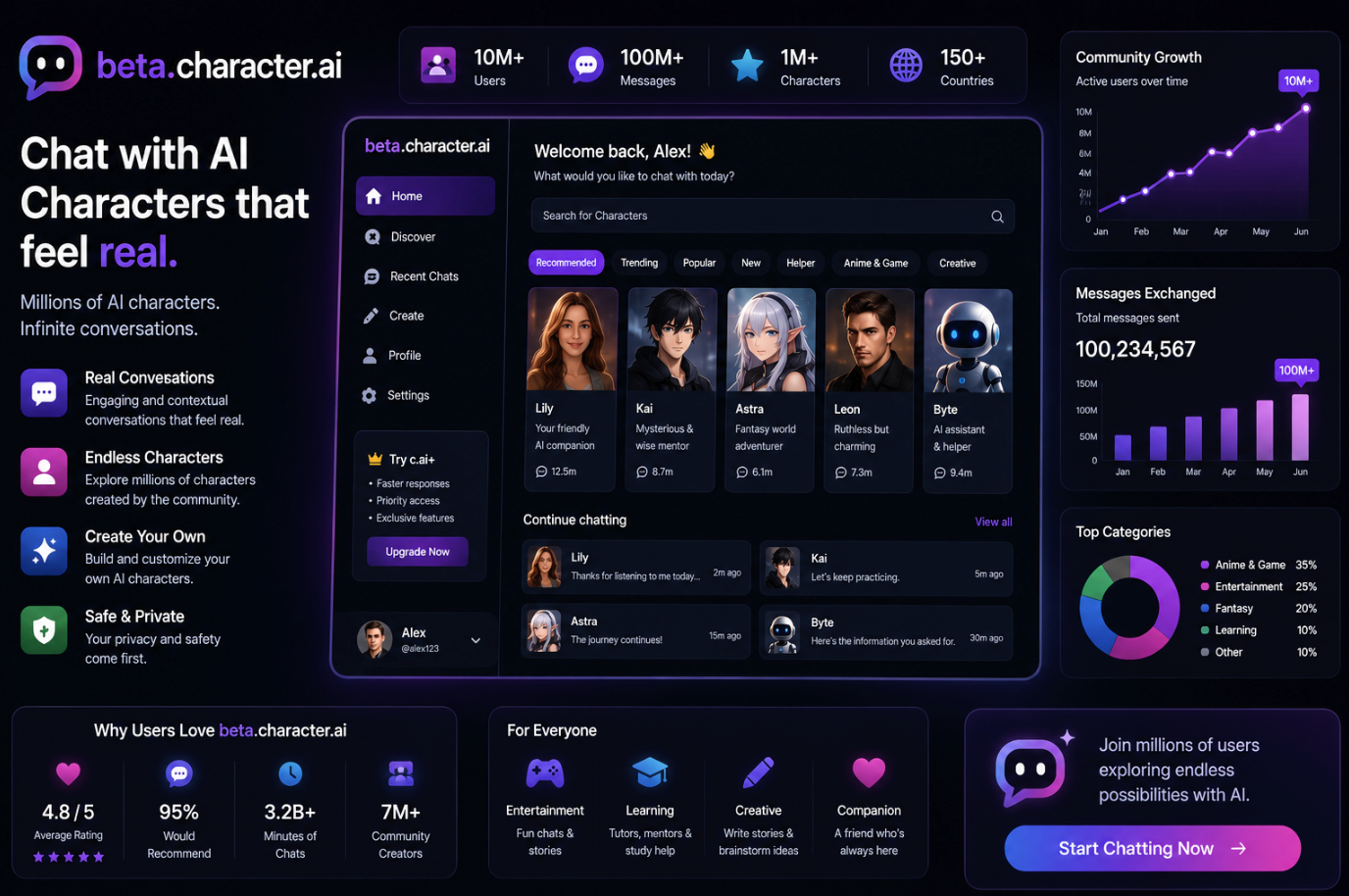
What the current Character.AI experience is like
For anyone approaching the platform fresh in 2026, the shape of the product is worth knowing before diving in.
The core loop remains character-driven chat: browse or search for a character, open a conversation, and interact through text. Characters vary from carefully crafted long-form personas — historical figures, mentors, fictional characters from popular media — to short user-created setups intended for casual roleplay or specific games. Voice output is available for many characters, though quality varies. Group-chat modes let multiple characters interact in the same conversation, which is one of the more distinctive features against category peers.
The free tier remains generous relative to some competitors, with reasonable message quotas and access to most characters. A paid tier (Character.AI Plus) provides faster responses, longer message limits, and priority access, and some newer features roll out to paid users first.
Character creation is available to any user, and the creation flow rewards patience. A well-scoped backstory, a clear personality prompt, an initial-message template, and a few example dialogue exchanges will produce a materially better character than a bare-minimum setup — which shows up immediately in the quality of the resulting conversation.
How the platform compares to what it launched as
Users who remember the 2022 beta and are trying to decide whether the modern product is worth returning to should calibrate on a few points.
The model is meaningfully better. Coherence, context retention, and character consistency have all improved. If the beta’s biggest frustration was characters drifting out of persona, that frustration is less common now.
The moderation is meaningfully stricter. Content that flowed easily in early 2023 will be blocked or softened today. Users whose use case depended on the older permissiveness will not find it here.
The community is different. The user base is larger and more mainstream, the character library is deeper but also more moderated, and the culture that existed in the early beta — the running jokes, the memes, the shared discovery of what the models could do — has diluted as the platform has professionalised. That change is neither good nor bad in any absolute sense; it is a normal maturing of a consumer product.
The alternatives are meaningfully better than they were in 2022. Anyone considering Character.AI in 2026 has a real menu of options to compare it against — Joyland AI, Crushon, Chai, Janitor AI, and a rotating cast of smaller platforms. The question is no longer “is this the only place to do this?” but “is this the right place for what I want?”
Practical guidance for anyone who searched this term
A short set of practical takeaways covers most of the reasons someone types “beta character AI” into a search bar today.
- The current URL is character.ai. The beta subdomain historically redirected and is no longer where the product lives.
- Existing accounts from the beta period still work; there is no need to recreate one unless you have lost access.
- If you are looking for less-restricted content behaviour, Character.AI will not provide it; competitor platforms exist and are easy to find.
- If you are looking for a genuine early-access beta test programme, there is no publicly enrollable one to sign up for as of 2026.
- If you were happy with the product and are simply looking for it again, the modern version is broadly stronger technically, tighter on moderation, and worth a fresh evaluation on its own terms.
A working perspective
The persistence of “beta character AI” as a search term is a small artefact of how consumer AI products get named, retired, and remembered. The platform that made the phrase famous still exists; it lives at a slightly different URL, ships stronger models, and enforces a different content policy than the version many users remember. Whether that combination is worth their time is a personal judgement — one that is easier to make once the history is clear.
What is worth noticing, beyond the specific case, is how quickly consumer AI products accumulate their own folklore. Two years is enough for a URL to shift, a founding team to relocate, a content policy to reverse course, and a user community to fragment across half a dozen alternatives. Anyone getting into the character-AI space today should expect the platforms they choose now to look similarly different in another two years. Pick the tool that suits the current moment, but keep the door open to switching. The category rewards portability of habit over loyalty to any single site.