Blooket Bot: The Types, Mechanics, and Classroom Response
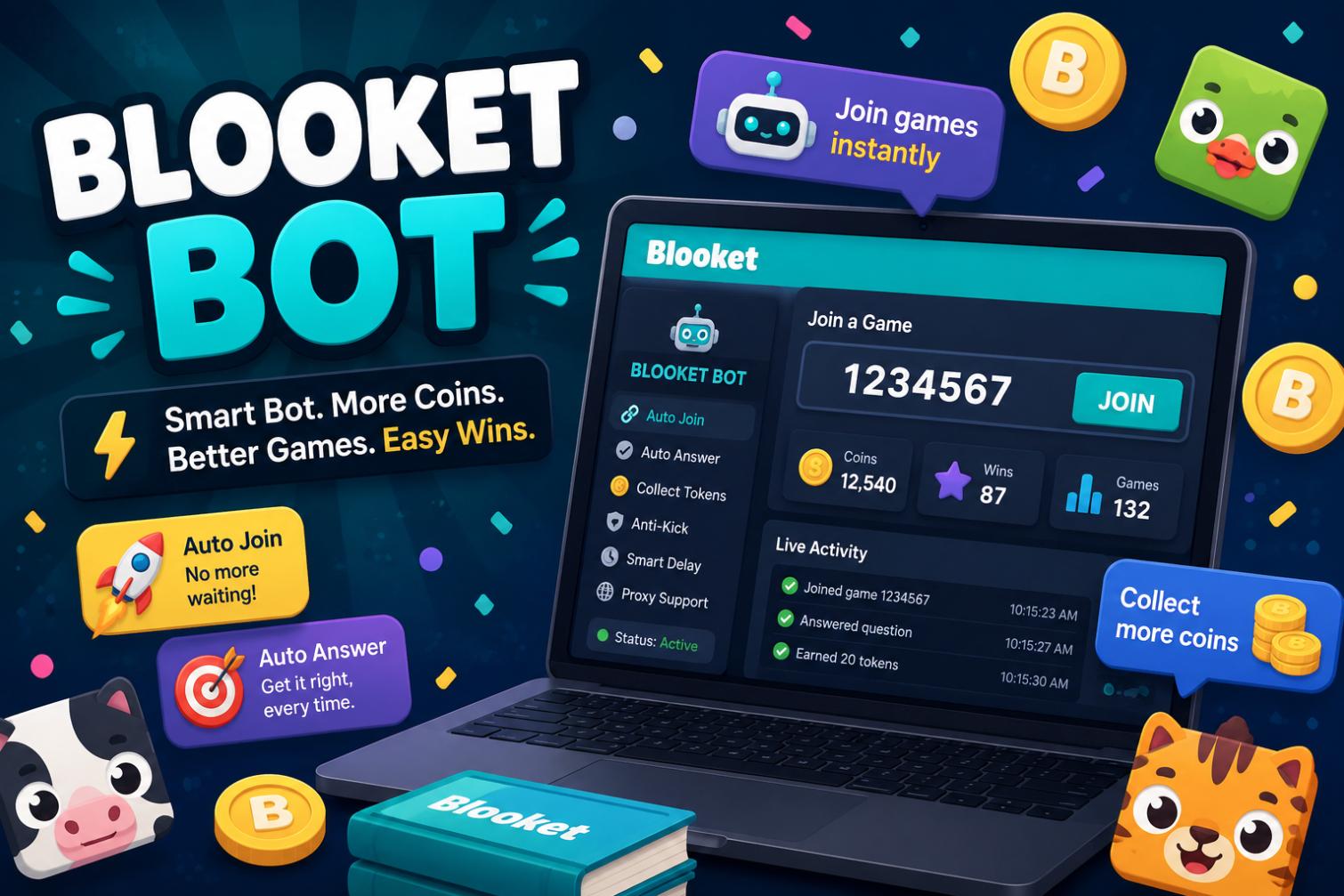
A classroom set is running Blooket. Twenty-eight students are in the lobby, tokens ready, and then — quietly at first, then all at once — the lobby balloons. Fifty extra players. Two hundred. A thousand. Names like “GayLordSupreme_1287” and generic tags scroll past. The teacher’s carefully planned review session is now a spam wall, and somewhere in the room a student is grinning at their phone. That is the small, familiar shape of a Blooket bot in the wild.
The term “Blooket bot” covers a family of scripts, browser extensions, and web tools that automate interactions with Blooket games — the popular quiz-based classroom platform used across primary and secondary schools since roughly 2020. What follows is an honest tour of what these tools actually are, who uses them and why, how the technology on both sides is evolving, and how teachers and administrators respond in 2026.
What a “Blooket bot” actually does
Not all Blooket bots do the same thing. Grouping them by function is more useful than treating them as a single category.
Flooders
The most visible category. Flooders inject large numbers of fake players into a live game lobby using its join code. They typically fire dozens to thousands of automated join requests, each producing an entry with a randomised or user-chosen name. The purpose is disruption: overwhelming the lobby, spamming visible names, or crashing the session before it can meaningfully begin.
Answer bots
These read the question shown on screen (usually via the visible DOM or a hooked API request) and return the correct answer automatically. The student, in effect, is playing perfectly without knowing the material. Answer bots are quieter than flooders and easier to miss, which is what makes them harder for teachers to catch during a session.
Token and stat manipulators
A separate category targets Blooket’s out-of-game economy: token farming scripts, XP inflation tools, and — historically — attempts to unlock premium characters (called “Blooks”) without paying for them. Blooket has invested notably in countermeasures for these, and the arms race in this niche moves faster than in the disruption categories.
Auto-hosts and bulk-players
Less common but still around: tools that automate hosting for multiple simulated games, useful for stress-testing or for scripted content creation. These sit adjacent to the ethical grey area of the other three, because they can serve legitimate research or QA purposes but usually do not in practice.
The mechanics behind them
Understanding roughly how these bots work explains both why they exist and why they periodically stop working.
Blooket’s game state is exchanged between clients and its backend through a mix of REST calls and real-time messaging (historically WebSocket-based). A bot developer inspects that traffic — typically by opening a browser’s developer tools during a normal game — and identifies the shape of the join, answer, and score-submission messages. Once the message shape is known, a small script can construct valid requests and send them at high volume without ever running the game UI.
Answer bots take a slightly different path. Instead of tapping the network protocol, they read the current question from the page’s rendered DOM, look up the correct answer (often by matching to a cached question bank scraped from public Blooket sets), and either display it to the user or auto-click the correct button. Some rely on the platform’s own API responses that inadvertently expose answer keys during play; those exposures have been progressively closed over time.
Blooket’s engineering team has pushed back throughout the years with rate limits, request-signing, obfuscated field names, session-integrity checks, and behaviour-analysis heuristics. Individual bots get patched out; new ones show up; the cycle continues. This is the same dynamic that shapes anti-cheat work in every consumer web game.

Who uses them and why
The user population is not what an anxious school newsletter might suggest. It clusters into a handful of overlapping groups.
Students seeking to disrupt a specific class session. The largest and loudest category. Motivations range from disliking a substitute teacher, to boredom, to social one-upmanship — being the person who “flooded” a lobby is a small currency of attention among peers. Most of this behaviour is more juvenile than malicious, but it can materially derail an instructional plan and impose real cleanup costs on teachers.
Students seeking an advantage on a graded activity. Answer bots serve this niche. Blooket is often used for review or formative assessment, and where any of the results tie into grades, an answer-bot user gets a scoring advantage without the corresponding learning. Educators frequently discover this after the fact — when a student who visibly zoned out ends up on the top of the leaderboard.
Developers and hobbyists. A smaller category treats Blooket bot development as a low-stakes reverse-engineering playground. Some contributors to the space maintain a distance from actual classroom use, focusing on the technical work and publishing tools without endorsing their deployment. This category exists across most online games and platforms.
Content creators. A visible but small group generates YouTube and TikTok content around Blooket bot demonstrations. This community has meaningfully driven the search volume around terms like “Blooket bot,” and its videos are often the entry point for younger students discovering the tools.
What teachers and administrators can actually do
Response strategies have converged over several school years of accumulated experience.
The single most effective intervention is closing the join loop. Blooket supports lobby locks after a game starts, capped attendee counts, and — for teachers using Class Sets or the paid Plus tier — pre-assigned participants who bypass open join codes entirely. Flooder bots depend on public join codes being usable by unknown clients; the more constrained the entry, the less useful the tool.
Session-management habits matter almost as much as platform settings. Sharing join codes only inside a physical classroom (not in Google Classroom announcements, not in Zoom chat, not on a slide projected to the internet during a lesson stream) removes most opportunities for external bot deployment. Starting the game immediately after code distribution, rather than waiting through a long lobby, shortens the window a determined student has to trigger a flood.
Reading the game data is the standard tool for detecting answer-bot use. Blooket’s reports show per-student response times and accuracy, and a student who answers every question in under a second with 100% accuracy is doing something the design of the platform did not anticipate. Where grades are attached, corroboration with in-class observation is worth building into the workflow before any accusation is made.
For educators facing repeat, targeted disruption, direct reporting to Blooket’s support team is a real option. The company has, in specific cases, banned repeat offenders and provided teachers with usable follow-up. That process is not fast, but it exists.
The wider picture in 2026
A few features of the current moment are worth noting for anyone thinking about Blooket bots at a strategic level rather than a session-management level.
Classroom platforms have become a normal target for adolescent hacking culture. Kahoot, Quizizz, Gimkit, and Prodigy all have parallel bot ecosystems. The dynamics on each platform vary, but the underlying phenomenon — students using accessible technical tools to disrupt or advantage themselves in adult-controlled software — is broad and probably permanent. Treating this as a Blooket-specific problem understates its footprint.
School AI-use policies are being rewritten. Most districts updated acceptable-use policies during 2023 and 2024 in response to generative AI, and many of those updates now cover automated tools of any kind. A student running a Blooket bot in 2026 is often violating a specific written policy, not just an unspoken norm — which changes both the disciplinary options and the conversations available with families.
Detection tooling on the platform side is improving. Behaviour heuristics on Blooket’s backend are quietly better than they were two years ago, and obvious flood attempts increasingly get filtered before they reach a teacher’s lobby. Anecdotal reports of “the old bots don’t work anymore” show up regularly on developer forums, which is what a maturing anti-abuse operation looks like from the outside.
A grounded perspective for both sides of the classroom
Before the takeaway, one more piece of context. Blooket’s popularity relies on a specific implicit contract between students and teachers — the game is engaging because it feels less like assessment and more like play, and both sides tacitly agree to keep it that way. Every flood attack, every answer-bot session, is a small breach of that contract. The reason those breaches matter is not primarily about the score sheet; it is about how quickly the platform loses the atmosphere that made it useful in the first place. Teachers who successfully manage the bot problem often do so less by clamping down than by preserving that atmosphere.
Blooket bots are not going away, but their impact is more manageable than the panic occasionally suggests. For teachers, the practical wins live in session management, platform settings, and reading the reports Blooket already provides. For students, the honest observation is that most of the flood behaviour trades short-term attention for real friction with peers, teachers, and increasingly with district-level policies — a trade that ages badly.
For everyone else — parents, administrators, ed-tech buyers evaluating Blooket versus alternatives — the useful reframe is that this category of software is doing what any live-response classroom tool has to do: balance ease of entry, engagement, and integrity. Every platform in the space is negotiating that balance imperfectly. What matters is whether the operator is investing in the negotiation, which by 2026 the Blooket team demonstrably is.