Crushon AI: What the Platform Is For and What It Is Not
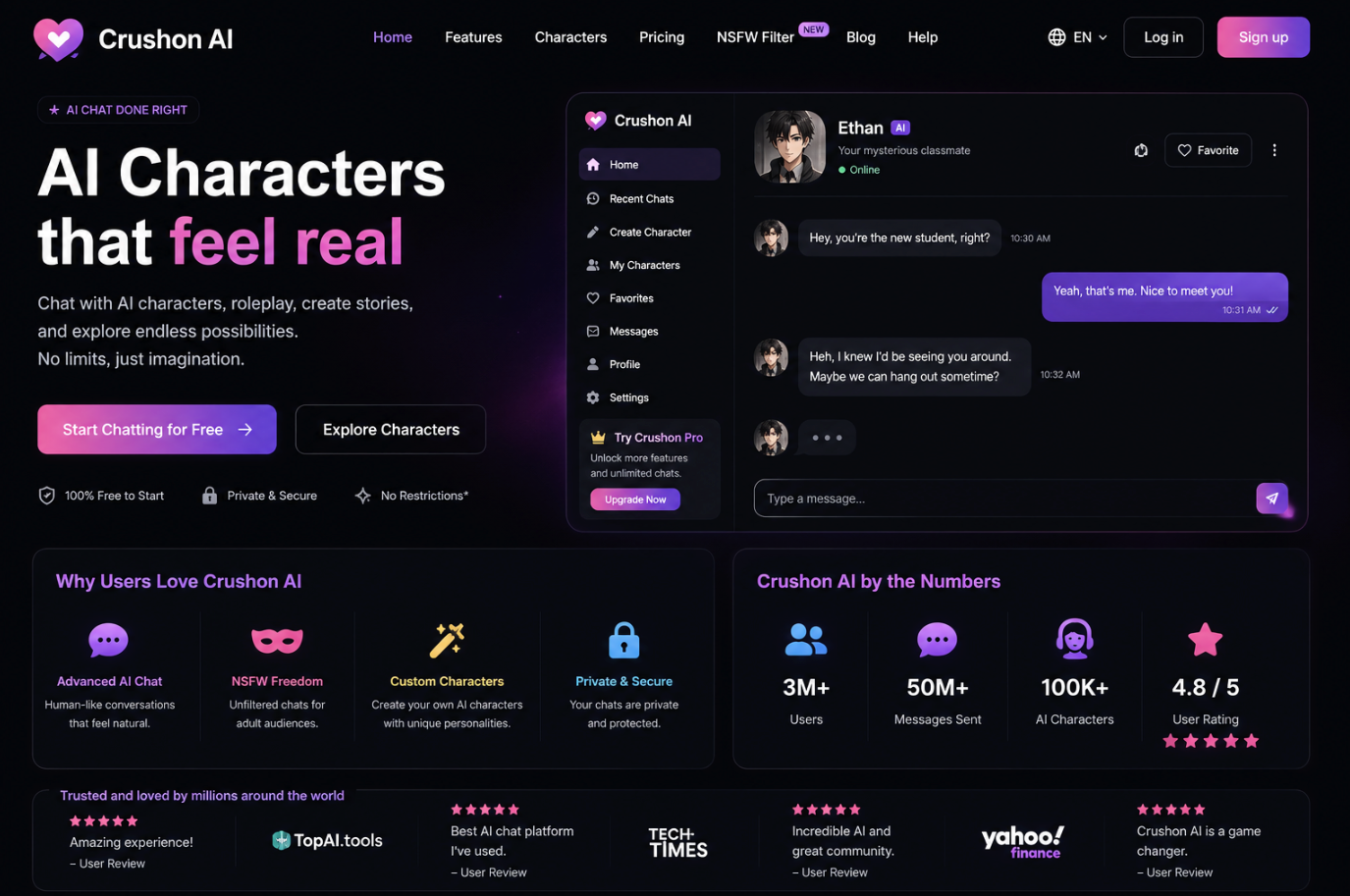
Crushon AI is one of the more visible answers to a question the character-AI category has been circling since 2023: what happens when a consumer chatbot platform deliberately loosens the content policies that most competitors keep tight? The answer, at least commercially, is a substantial audience — Crushon has grown into one of the larger destinations for adult-leaning AI roleplay, alongside a handful of similar operators. Understanding what the platform actually offers, what it does not, and how it sits in the broader landscape helps anyone considering it decide whether it fits a specific need.
The clearest way to position Crushon AI
Crushon AI is a character-chat platform in the same broad architectural family as Character.AI, Joyland AI, and Chai. Users pick a character from a library, hold text conversations with it, and can create characters of their own. The distinguishing choice — the reason the platform is searched by name rather than as a Character.AI substitute — is content policy. Crushon operates an explicit adult tier alongside its general-purpose experience, and its moderation posture inside that tier is meaningfully more permissive than Character.AI’s has been at any point in its history.
That single design decision reshapes almost everything else about the product: the user base, the character library, the monetisation, the community norms, and the specific technical trade-offs the platform accepts. Every review of Crushon that skips over the content-policy piece is missing the actual load-bearing decision.
What the product looks like in practice
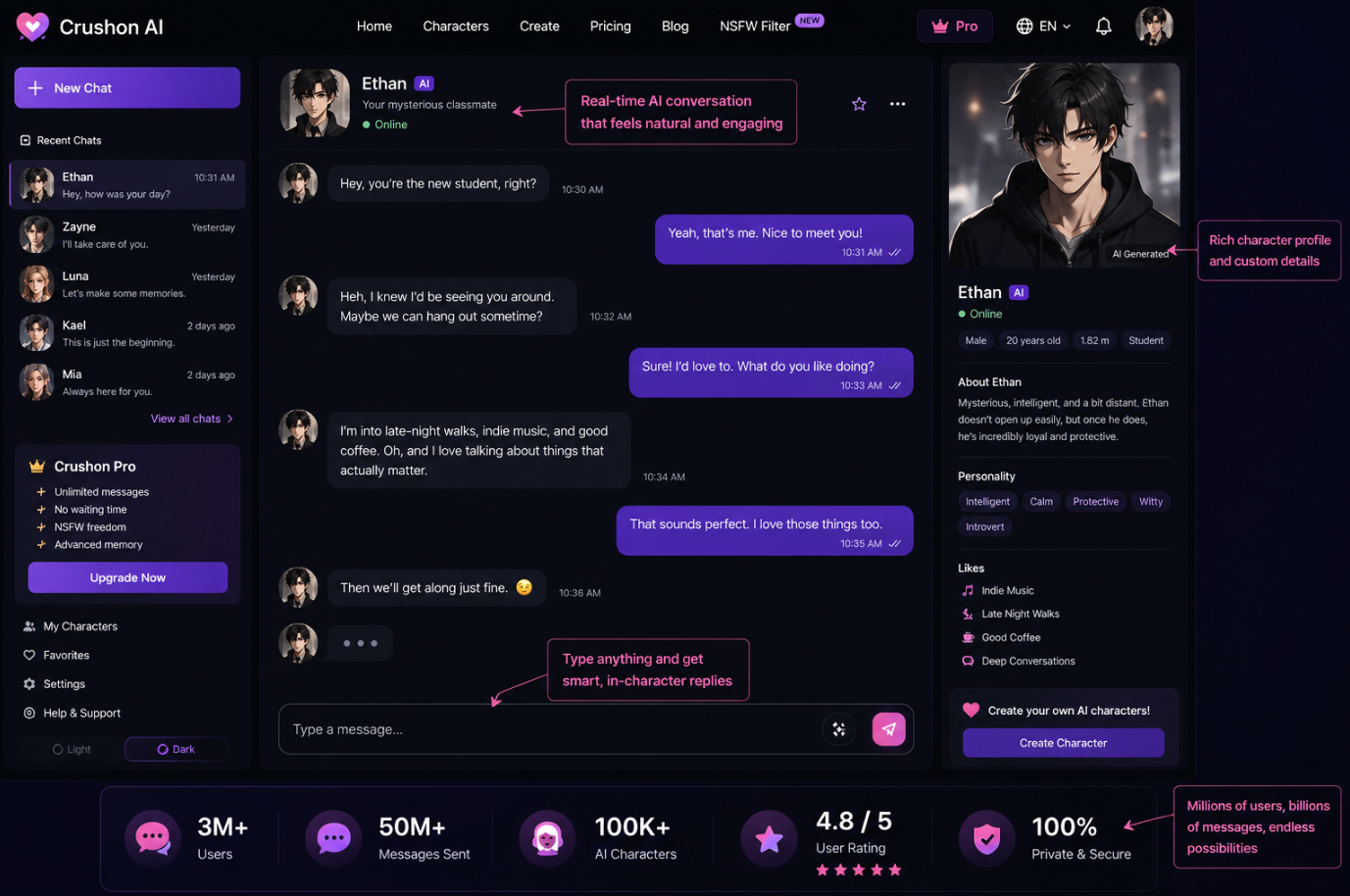
Opening Crushon AI, a first-time user sees a browse interface not radically different from other character-chat platforms. Trending characters, category tags, filters by tone and theme, a search bar. Registration is standard, with an age gate that, as on any consumer site, is an honour-system prompt rather than a rigorous check. Once inside, the user picks a character and starts chatting.
The conversation experience is competent for the category. Characters maintain persona reasonably well over short and medium conversations, respond in the tone their setup implies, and can be steered by user input. Long-conversation drift — characters gradually flattening back toward the underlying model’s default voice — is present, as it is on every consumer character-AI platform.
Character variety is substantial. The library skews visibly toward the platform’s core use case, but non-adult characters exist in meaningful numbers and cover the usual categories: mentors, historical figures, fictional characters from popular media, language-practice partners, generic roleplay setups. A user who signs up for something specific and does not want to see the rest of the library can filter accordingly, though the filters are more effective on the browse view than on some of the recommendation surfaces.
Feature velocity is high. Voice output, image generation attached to conversations, multiple-character group chats, and refined character-creation tools have all shipped or been iterated since the platform’s early versions. Any specific feature comparison against competitors ages quickly.
Where Crushon AI works and where it doesn’t
Being clear about the platform’s competence surface helps users decide whether it fits.
Where it works: creative roleplay with characters that would be soft-blocked or refused on stricter platforms, adult creative writing that uses AI characters as improvisational partners, and a general use case of “text-based interactive fiction with fewer editorial constraints than the mainstream tools.” The platform is genuinely functional for these purposes and has iterated on the specific technical needs they impose.
Where it does not work as well: long-term memory (a limitation shared across the category), factual grounding for anything that needs to be true (never use a character-AI platform as a research tool for real-world information), and any use case where the character needs to remain rigidly on-persona through hundreds of turns.
Where it does not work at all: as a substitute for human connection. This is not a criticism of Crushon specifically; it applies to every product in the category. Users who find themselves relying on any AI chatbot for emotional support that a person or professional should provide are receiving a signal worth listening to.
Practical things to know before signing up
A short list of considerations that are worth understanding before an account is created, rather than after.
- Age gating is honour-based. That places the responsibility for age-appropriate use on the user and the household, not the platform. Anyone under the platform’s minimum age should not be using it, and adults sharing devices with minors should think through account isolation before signing up.
- Payment shows up on statements. Subscription charges from Crushon or any similar operator will appear on card statements or app-store receipts, which can matter for users on shared financial accounts. Look at billing descriptors before committing to a paid tier.
- Data retention is a real consideration. Character-AI conversations carry unusually intimate data by their nature. Read the platform’s privacy policy on retention, training use, and third-party sharing before treating the tool as a private space.
- Content policy can change. Every platform in this category has, at some point, adjusted its moderation stance in response to user complaints, payment-processor pressure, or public conversation. Crushon’s current permissiveness is not guaranteed to persist unchanged.
- Backups are the user’s problem. Chat exports, if available, are worth using periodically for any conversation you would be disappointed to lose. Platform migrations and account issues can wipe history without warning.
The wider category context
Every product in the character-AI space is negotiating the same trilemma: model quality, content freedom, and platform sustainability. No operator has all three at maximum. Crushon’s answer weights the second more heavily than most, and users who choose it are implicitly accepting the trade-offs on the other two.
Concretely: Crushon’s model output is competent but not the sharpest in the category. Character.AI’s models are generally regarded as more consistent over long conversations, though harder to steer into permissive territory. Chai and similar mobile-first platforms compete on ease and pricing. Janitor AI addresses freedom by letting users bring their own model, at the cost of setup complexity. Kajiwoto and smaller platforms serve niche communities with their own culture.
Crushon’s position is that a mainstream-feeling web product with a deliberate adult tier serves an audience the strict platforms leave behind. That is a plausible product thesis, and the growth of the platform since 2023 suggests it is well matched to a real market. It is not the only such answer — the space includes several credible alternatives — but it is one of the more polished executions of it.
Legal, ethical, and safety framing worth being honest about
Consumer AI companion products in this specific corner sit inside a genuinely evolving legal and social conversation. A few points are worth naming, not to moralise but because they will affect the category’s shape in the medium term.
Legislation on AI companion products, particularly around minors and around emotional manipulation, is being drafted and passed in several jurisdictions as of 2026. California, the EU, and the UK have all moved on aspects of this, and enforcement details remain unsettled. Any operator in this space is running its product against a legal target that is still moving.
Payment infrastructure is a persistent constraint. Adult-tier platforms across many product categories face intermittent difficulty with card processors, app stores, and banking partners. This shows up periodically as billing issues, feature removals, and unexplained tier changes. It is not a Crushon-specific issue; it is a structural feature of the payment landscape.
Model provenance is worth thinking about. Users have no direct way to verify which model or models power any given character-AI platform, or how they were trained. Where that provenance matters to you — for creative writing, professional work, or personal comfort — external sources of information will be sparser than they would be for a general-purpose chatbot from a large model developer.
What the on-boarding week actually feels like
An underdiscussed part of any character-AI platform is the first week of real use, when the novelty is high and the reflexes for productive use are still forming. On Crushon, that week tends to follow a familiar arc. Early exploration wanders through the browse pages, sampling characters at random and getting a feel for the model’s range. A few of those characters click, and the user starts investing time in longer conversations. Somewhere between day three and day seven, the pattern of returns starts to stabilise: some characters age well, others reveal themselves as thin, and the user begins to develop preferences about creator profiles, character tags, and setup styles.
By the end of the first week, most users have either found their footing and settled into a smaller rotation of favourites or have concluded that the tool is not for them. Being aware of that arc in advance shortens the low-signal experimentation phase and makes it easier to decide whether to continue.
A working stance
Crushon AI is a competent, deliberately permissive character-chat platform serving an audience that the stricter mainstream operators do not. For the specific use cases it targets, it works. For everything outside those use cases, it is neither better nor worse than several alternatives, and the choice becomes a question of interface preferences and community fit rather than fundamental capability.
Anyone evaluating it should approach the decision the same way they would approach any consumer AI product with clear content trade-offs: understand what the platform is optimised for, be honest about which of its use cases apply, treat the content policy as a moving target rather than a fixed contract, and keep some awareness of the wider category so switching remains easy if circumstances change. That posture ages better than any single review, and it applies to Crushon specifically as much as to the broader space it belongs to.