FaceCheck.ID [What the Face Search Engine Is and Its Limits]
![FaceCheck.ID [What the Face Search Engine Is and Its Limits]](https://transcriberry.com/blog/wp-content/uploads/2026/07/facecheck-id.jpg "FaceCheck.ID [What the Face Search Engine Is and Its Limits]")
FaceCheck.ID is a facial-recognition search engine that takes a photo of a person and returns other places on the web where that face appears. It sits inside a specific category of tools — PimEyes is the most prominent competitor — that have moved facial-recognition capabilities from law-enforcement and specialised commercial contexts into consumer-accessible products. The category exists at the intersection of legitimate use cases, serious privacy considerations, and a rapidly evolving legal landscape. Understanding what FaceCheck.ID actually does, what it can and cannot find, and what the broader considerations are is important both for anyone thinking about using it and for anyone whose face may appear in its index.
What the tool actually does
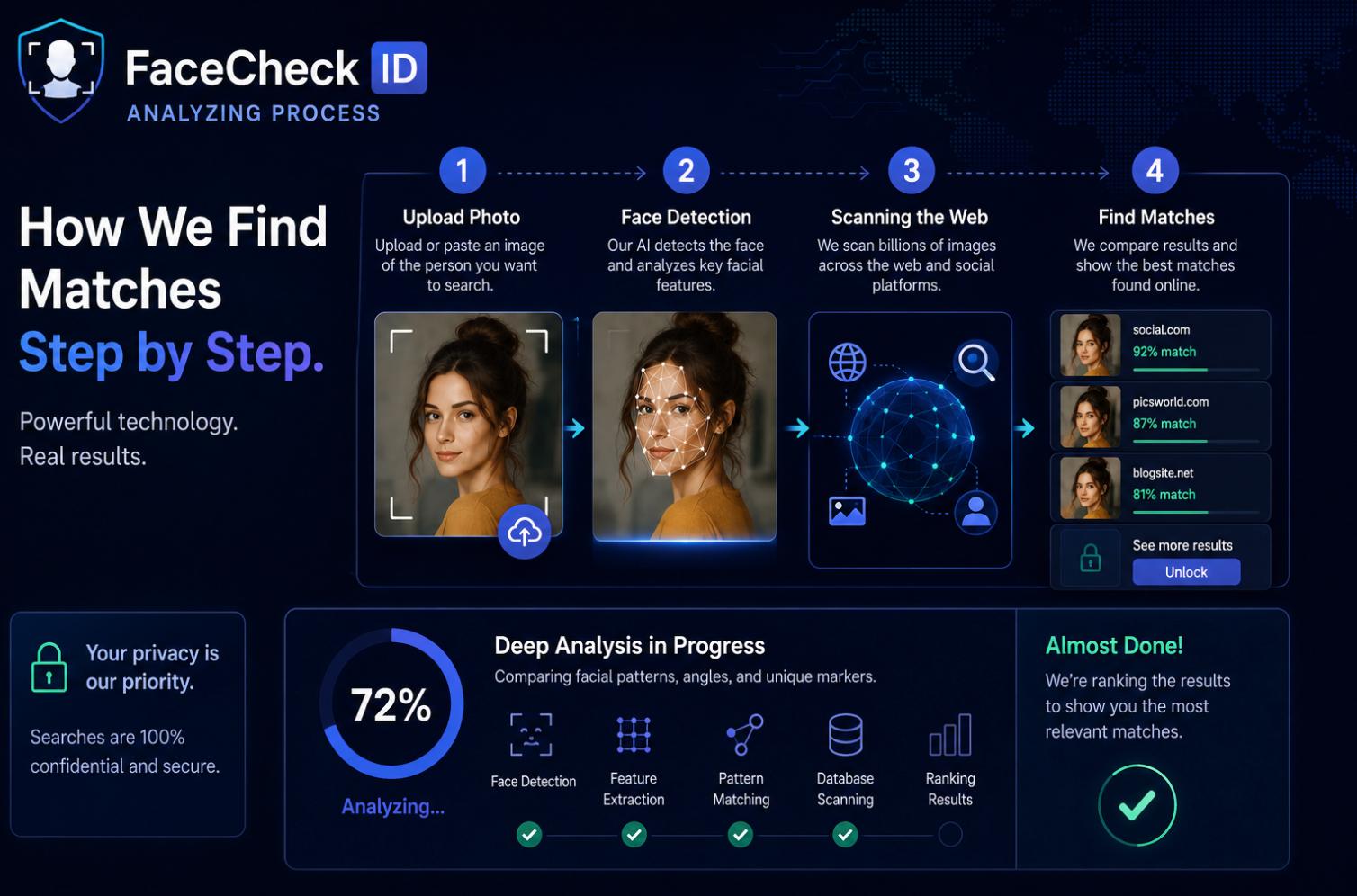
The technical picture is straightforward. A user uploads or provides a photo of a face. The service extracts facial-recognition features from the photo — the specific mathematical fingerprint that identifies the face independent of angle, lighting, or expression — and searches its index of images scraped from the public web for matches. Results are returned as a list of pages where the same face appears, ranked by confidence, with the surrounding context of each match (the source URL, the surrounding image, sometimes captions).
The underlying capability has existed in academic and law-enforcement contexts for years. What FaceCheck.ID and similar consumer services have done is make that capability accessible through a browser to anyone willing to pay a monthly fee, and free (with restrictions) to anyone willing to accept limited results. That accessibility is the specific change that has made the category a policy conversation rather than a technical one.
The legitimate use cases
Users approach the tool for a specific set of reasons that are genuinely defensible.
Verifying a stranger’s identity in an online context. Someone matched on a dating app whose profile pictures feel too polished, someone offering a business opportunity that seems off, someone reaching out with a story that does not add up. In each of these situations, running the profile picture through a reverse face search can quickly reveal whether the person is who they claim to be, or whether the same photos appear on completely unrelated profiles.
Recovering lost identity information. Users who once had a specific photo of themselves and lost the source, users trying to trace a family member from an old photograph, users doing genealogical research with limited surviving image records. These are the specific cases where a face-search tool solves a problem no other tool solves.
Personal security and stalker research. Users who are worried about a specific person can check whether photos of themselves that they thought were private are appearing on unfamiliar sites. This use case is more common than casual readers realise.
Journalism and open-source investigation. Reporters and researchers use face-search tools as part of verification workflows — identifying subjects in photos of protests, confirming identities of public figures in unofficial photographs, and following leads across multiple platforms. Bellingcat and similar investigative organisations have integrated these tools into their standard workflow.
Where the concerns are genuine
The same capability that makes the tool useful in the legitimate cases above makes it dangerous in the illegitimate ones. Being honest about the concern is important.
Stalking and harassment. The direct concern with any facial-recognition search tool is that it lowers the barrier to identifying and tracking specific people. A stranger’s photograph plus a face-search query can produce that stranger’s social media presence, professional profile, personal blog, and other identifying information in seconds. That capability is a significant asymmetry — the target has no way to know they have been searched.
Non-consensual identification. People who appear in photographs on public websites without expecting to be findable by face search — protesters in old news photos, extras in social-media backgrounds, people who commented on forums with a profile picture years ago — are all findable through these tools regardless of their current preferences. Their consent to be photographed at the time did not include consent to be indexed by a face-search engine.
Doxing infrastructure. Face-search tools are one of several tools that collectively lower the barrier to constructing detailed personal profiles of individuals from limited starting information. Their addition to a doxing toolkit is a specific concern.
Data protection and legal compliance. Facial recognition of unconsenting individuals is regulated more strictly in some jurisdictions than in others. The European Union’s AI Act has specific provisions on facial recognition, the UK has its own regulatory framework, several US states have adopted biometric privacy laws (Illinois’s BIPA being the most active in practice), and enforcement is inconsistent but real. Both users and operators of face-search tools operate under this evolving legal picture.
The user’s practical picture in 2026
For anyone thinking about actually using FaceCheck.ID, the practical picture involves a few specifics worth understanding.
The free tier provides limited results. Full result sets, higher-quality matches, and additional context are behind a paid subscription. The monthly cost has varied over the years.
Result quality is uneven. The tool is genuinely capable, but it does not find every appearance of a face on the internet, and it produces false-positive matches for people who look similar to the query. Any match should be verified through the surrounding context before being treated as definitive.
The tool improves over time. Every search a user makes contributes indirectly to the ecosystem — through the queries themselves, through the images uploaded, and through the corrections users apply to results. This is a general property of machine-learning-driven services and is not unique to FaceCheck.ID.
Terms of service constrain use. FaceCheck.ID publishes terms that prohibit specific uses — stalking, harassment, unauthorised background-check purposes. Enforcement of these terms is a real question, but the terms themselves are relevant if the tool’s use ever becomes a legal matter.
What is worth knowing if you might be indexed
Anyone whose photo appears anywhere on the public internet is potentially findable through a face-search tool, whether they know it or not. A short set of practical considerations helps manage this.
Opt-out mechanisms exist. FaceCheck.ID publishes a process for removing photos of yourself from their index. Similar tools have their own processes. In jurisdictions with data-protection law, formal removal requests carry legal weight even where the tool’s operator is based elsewhere.
Public photos accumulate. A single photo you posted publicly five years ago may be indexed by multiple face-search tools now. Cleaning up an individual’s face-search footprint is a multi-week process that involves identifying the images, requesting removal from each source, and following up with the search tools themselves.
Personal photo hygiene going forward matters. Users concerned about their face-search visibility can adopt specific habits — restricting the audience for personal photos, avoiding face-forward profile pictures on identifying accounts, being deliberate about which photos are actually public. None of these are foolproof, but each reduces the search footprint.
Family members’ photos matter. A photo of you on a family member’s public social media account will be indexed even if you have no public account of your own. This is worth having a conversation about within families that care about privacy across generations.
The wider category and its trajectory
FaceCheck.ID is one of several tools in a specific category — PimEyes is the most-searched name in the space, and other services with varying levels of visibility exist. The category has grown quickly since 2021 and is likely to continue growing until either regulation constrains it or user behaviour shifts around it.
Two trends are worth noticing. Regulation is moving faster than user awareness, and specific enforcement actions in the EU, UK, and Illinois have already produced meaningful settlements and behavioural changes. Meanwhile, the underlying technology continues to improve, and the specific capabilities of face-search tools in 2028 will exceed what is available today by a substantial margin. Anyone thinking about this category from either the user side or the subject side benefits from tracking both trends.
Comparing it with PimEyes and similar services
A short comparison with other tools in the space clarifies where FaceCheck.ID specifically sits.
PimEyes was the earlier and more prominent entrant in the consumer face-search category and has faced significant regulatory attention in the EU. Its capability is comparable to FaceCheck.ID’s, its pricing model is similar, and it has invested visibly in opt-out and rights-management infrastructure in response to regulatory pressure.
Clearview AI, the most-discussed name in the space, operates in a different market — its primary customers are law enforcement rather than general consumers, and it has faced substantial legal action across multiple jurisdictions over its data-collection practices. Consumers do not have direct access to Clearview.
Various smaller and less-established services have entered and exited the space, some of them of dubious operational quality. Users evaluating options should stick to the more visible and accountable operators; the smaller ones carry both technical and legal risks that outweigh their marginal value.
FaceCheck.ID’s specific positioning within this landscape is as a general-purpose consumer tool with reasonable technical quality and a moderate pricing model. That fits some legitimate use cases well; it also makes the tool a specific participant in the wider policy conversation about consumer face-search access.
A working stance on the tool
FaceCheck.ID is a genuinely capable facial-recognition search engine. It has real legitimate uses and real potential for harm, and no user of the tool should approach it without thinking through which of the two their specific query represents. For subjects whose faces are already in the index, opt-out processes exist and are worth exercising. For everyone else, the tool is a specific example of what consumer-accessible AI infrastructure has become in the 2020s — powerful, fast, cheap, and requiring a set of ethical calibrations that the technology itself does not provide.