FNaF 2 Unblocked (Mechanics, Ports, and First-Night Habits)
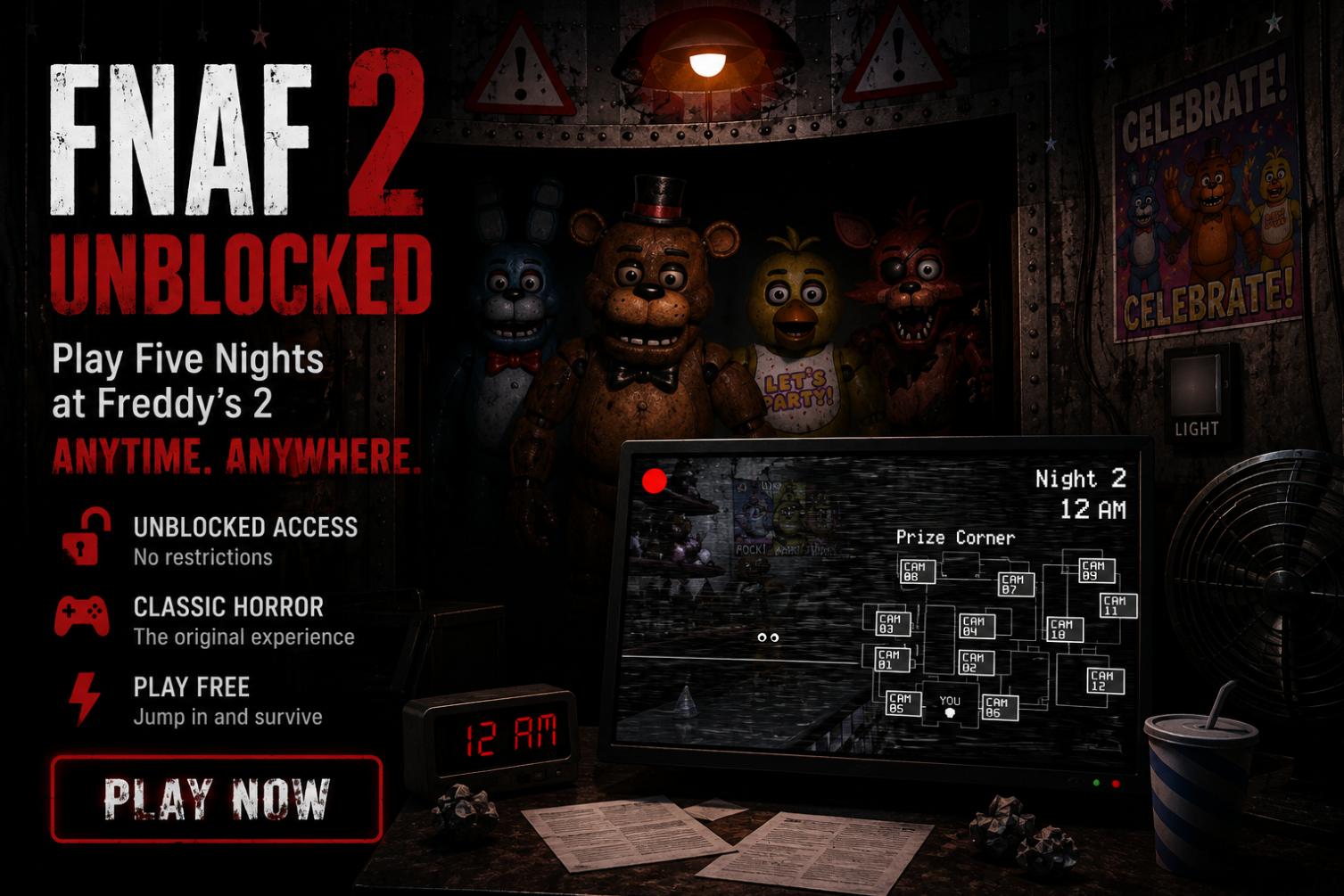
Five Nights at Freddy’s 2 is one of the more mechanically distinct entries in Scott Cawthon’s long-running series — released in late 2014, tighter than the first game, and mechanically ambitious in ways that the debut wasn’t. The persistent search behaviour around FNaF 2 in browser form reflects a specific reality: the game has a stable audience that includes many players on school-issued devices or restricted networks who cannot install it directly. This piece walks through what the game actually asks of the player, how the browser versions handle it, and what a first-time player should know before starting a night.
What sets FNaF 2 apart from the first game
The first Five Nights at Freddy’s, released earlier in 2014, established the core loop: static camera monitoring, animatronic threats that move only when unobserved, resource management against a limited power supply, and a single-location horror atmosphere that produced a viral audience. FNaF 2 kept the loop and added complexity across several axes at once.
The Freddy Fazbear’s Pizza in the second game is not the same restaurant — it is an earlier, larger version, with more open corridors, more animatronic variety, and no security doors. The power meter that dominated the first game’s resource management is gone. In its place is a set of new mechanics — a Freddy Fazbear mask that convinces certain animatronics you are one of them, a flashlight with limited battery, and a music box that must be periodically wound remotely to keep a specific antagonist docile.
The result is a harder, faster-paced game than the original. The player has more variables to track at once and more time-sensitive decisions to make. Long-term FNaF players often cite FNaF 2 as the mechanically peak entry in the series, and its specific design choices influenced the horror-game category well beyond the FNaF brand.
How the actual gameplay works
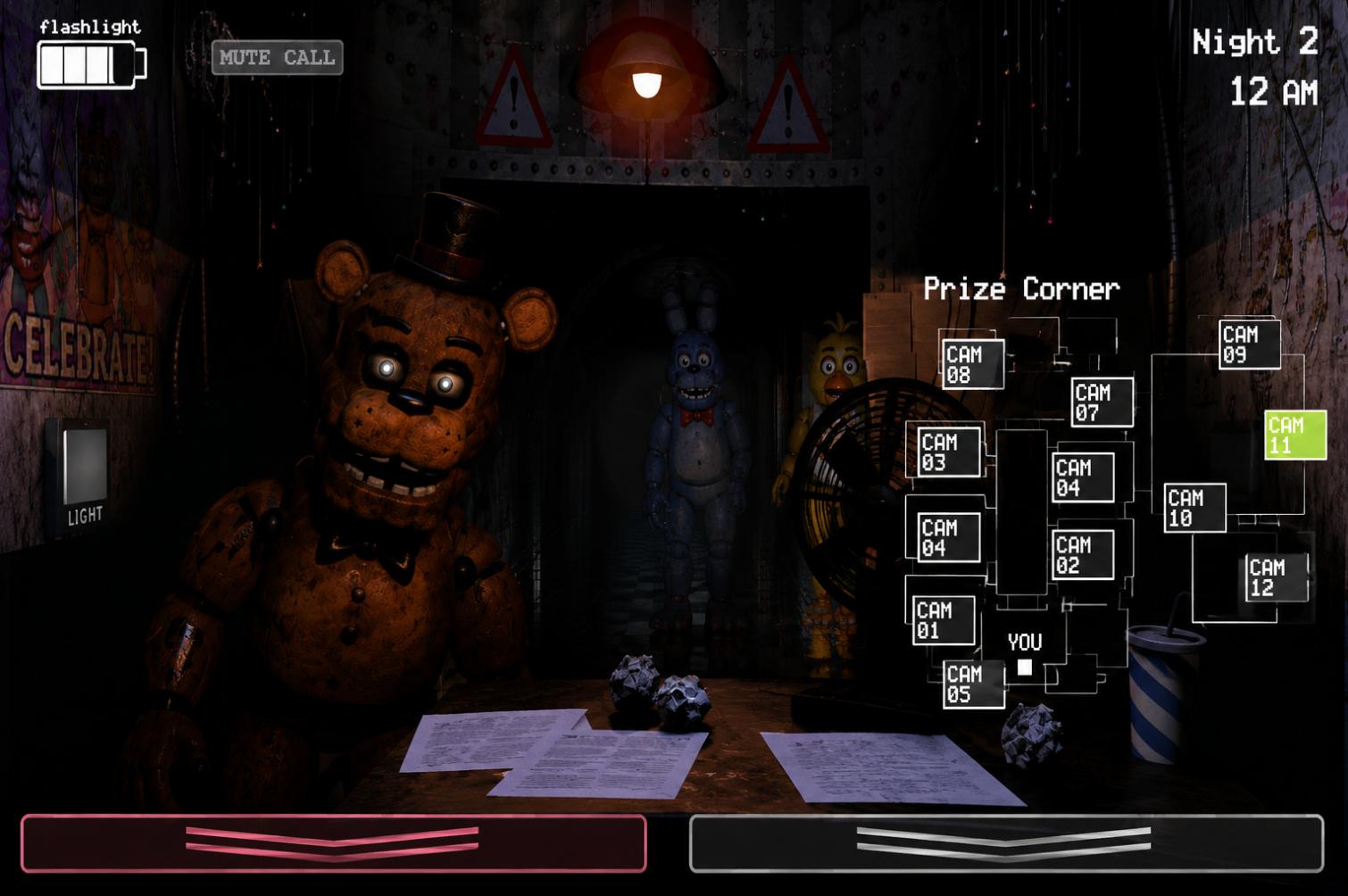
The player’s job is to survive five in-game nights (with additional challenges unlockable after that). Each night runs a fixed real-world duration, during which the player alternates between checking cameras, using the flashlight to check the corridor ahead, deploying the Freddy mask when animatronics approach, and winding the music box remotely.
The camera system
Checking cameras uses attention and time, both of which are finite. The player cannot both watch cameras and respond to a threat approaching the office at the same time. Learning which cameras are worth checking, and when, is the first meta-skill FNaF 2 rewards.
The Freddy mask
Certain animatronics that enter the office can be deceived by putting on the Freddy Fazbear mask. Others cannot. Knowing which is which — and, more subtly, knowing not to use the mask on animatronics that ignore it — is central to survival. Applying the mask at the wrong moment is one of the most common causes of death.
The flashlight
The corridor ahead of the office is dark, and the flashlight is the only way to check it. The battery is limited across the whole night. Learning to use the flashlight economically — brief checks rather than sustained illumination — is a specific rhythm the game teaches.
The music box
The Puppet, one of the animatronics, becomes active if the music box winds down. The music box must be periodically re-wound remotely via a camera. Neglecting it triggers a game state that is essentially unrecoverable. New players routinely die to this on the first few attempts before internalising the rhythm.
The animatronic roster
FNaF 2 introduces significantly more animatronics than the first game, including both original and “toy” versions. Each has specific behaviour patterns, movement triggers, and countermeasures. Learning the roster is the medium-term skill the game rewards.
The unblocked-browser experience
Playing FNaF 2 in browser form on an unblocked-games mirror produces an experience that ranges from very good to compromised depending on the specific port.
The best ports use accurate reimplementations of the game logic, run at a stable frame rate, preserve the game’s audio design intact, and provide keyboard-and-mouse controls that map cleanly to the original interface. On a modern Chromebook, these ports deliver a genuinely playable experience.
Weaker ports run at lower frame rates, drop or replace parts of the audio track, or introduce ad interstitials between nights. The audio is particularly load-bearing in FNaF 2 — many of the animatronic cues are audio-first, and losing them removes an entire perceptual channel the game depends on.
The intended way to play the game remains the official version, which is available on Steam, iOS, and Android. Users with any of those platforms available should reach for the official release rather than a browser port. The browser experience is a workable substitute rather than an equal alternative.
Difficulty progression and the specific spikes
FNaF 2’s night-by-night difficulty progression is worth understanding for new players.
Night 1 introduces the mechanics gradually. Most animatronics are docile; the player has time to learn the camera interface, the mask, and the flashlight. New players still lose here regularly, but recovery is fast.
Night 2 introduces meaningful pressure. Multiple animatronics are active, the music box requires attention, and the pace of decisions accelerates.
Nights 3 and 4 are where most players stall. The number of simultaneous threats climbs, the tolerances tighten, and mistakes become expensive. A player who makes it through night 4 has usually acquired most of the game’s core skills.
Night 5 and beyond are exercises in optimisation. The player has all the tools needed to survive; execution is the challenge. Custom Night, unlocked later, is where the true FNaF 2 challenge lives, and completing it is a genuine feat.
The wider FNaF context
FNaF 2 sits inside a specific media franchise that has grown far beyond a single game. Scott Cawthon released four more numbered entries, several spin-offs, a novel series, and licensed products; the film adaptation released in 2023; and the community has produced an enormous quantity of fan games, videos, and analysis. Newer entrants to the space often start with FNaF 2 specifically because it hits the mechanical sweet spot the series has been iterating around ever since.
The lore layer — the specific narrative about the pizza restaurant, the animatronics, and their history — has become a major part of the franchise’s appeal. FNaF 2 introduces several plot elements that become load-bearing across later games. A player interested in the story will find the second game richer than a first pass suggests.
A short guide for a first-attempt player
Anyone starting the game today, in browser or elsewhere, benefits from a small set of first-attempt habits.
Play with sound on and, ideally, with headphones. The audio is more important than the visual monitoring in most survival situations.
Learn the map layout before starting. A few minutes checking cameras in the opening night to memorise the geography saves lives later.
Wind the music box early and often. Many first deaths come from forgetting it in the middle of another crisis.
Do not overuse the flashlight. Corridor checks are quick; sustained illumination drains the battery faster than users expect.
Accept early failure as part of the learning. FNaF 2 teaches through death, and expected fatalities in the first few nights are how you build the muscle memory the later nights require.
What FNaF 2 does that later horror games have picked up
A useful bit of historical context for anyone who plays modern horror games is how much of the current design vocabulary FNaF 2 helped establish. The game’s specific combination of features — resource management under time pressure, multiple simultaneous threats requiring specific countermeasures, audio-first tension design, and a session structure short enough to sustain repeat attempts — has been echoed across a wide range of horror games since.
Poppy Playtime’s environmental puzzle structure, Piggy’s map-and-antagonist dynamic, various Roblox horror hits, and even higher-budget productions like Alien: Isolation share design DNA with what FNaF 2 codified. Recognising that lineage helps a player understand what they are actually engaging with when they play the game.
Some considerations for younger players
FNaF 2, like the wider FNaF franchise, is rated for older children and teens. It relies heavily on jump scares, and the specific tension design can be genuinely unpleasant for younger or more sensitive players. Parents whose children are drawn to the game because of TikTok content or friends’ enthusiasm benefit from understanding what the game actually contains before allowing extended play.
The lore layer, discussed briefly above, includes some darker themes involving the fictional restaurant’s history. These themes are threaded through the wider franchise rather than being front-and-centre in gameplay, but they exist and are worth being aware of for anyone reviewing the game for age-appropriateness.
A short close
FNaF 2 is a specific, mechanically rich entry in one of the most durable independent horror franchises in gaming. Playing it in browser form is a workable path when official installation is not available, and the community around the game continues to bring new players to it years after release. Whether the browser experience meets expectations depends heavily on the specific port; whether the game itself meets expectations depends on the player’s willingness to engage with its specific mechanics rather than treating it as a generic jump-scare experience. Given both, the game holds up.