Gramhir Pro: What It Does, Its Limits, and When to Use It
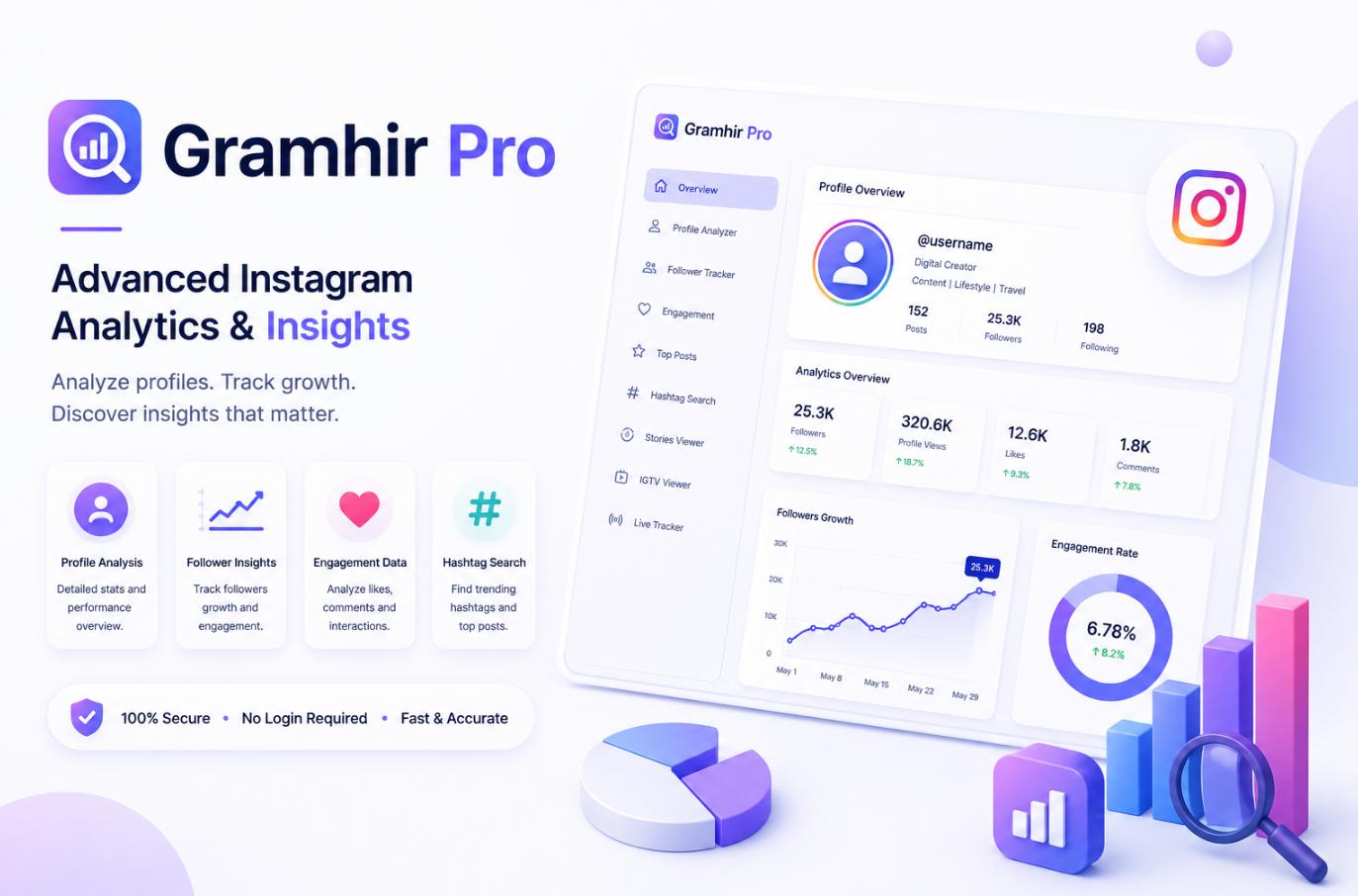
Gramhir Pro sits in a corner of the internet most people never notice until they need it: third-party Instagram analytics and profile viewers that operate outside Meta’s official ecosystem. The tools in this category serve a few very different audiences — small creators trying to understand their own account, marketers running competitive research, curious visitors trying to peek at profiles without logging in, and users who have been blocked and want a workaround. Gramhir Pro’s positioning tries to serve most of them at once.
Whether that positioning makes it worth using depends on which of those needs actually applies to you, and on how comfortable you are with the trade-offs that come attached to any tool sitting outside a platform’s official API.
The core promise
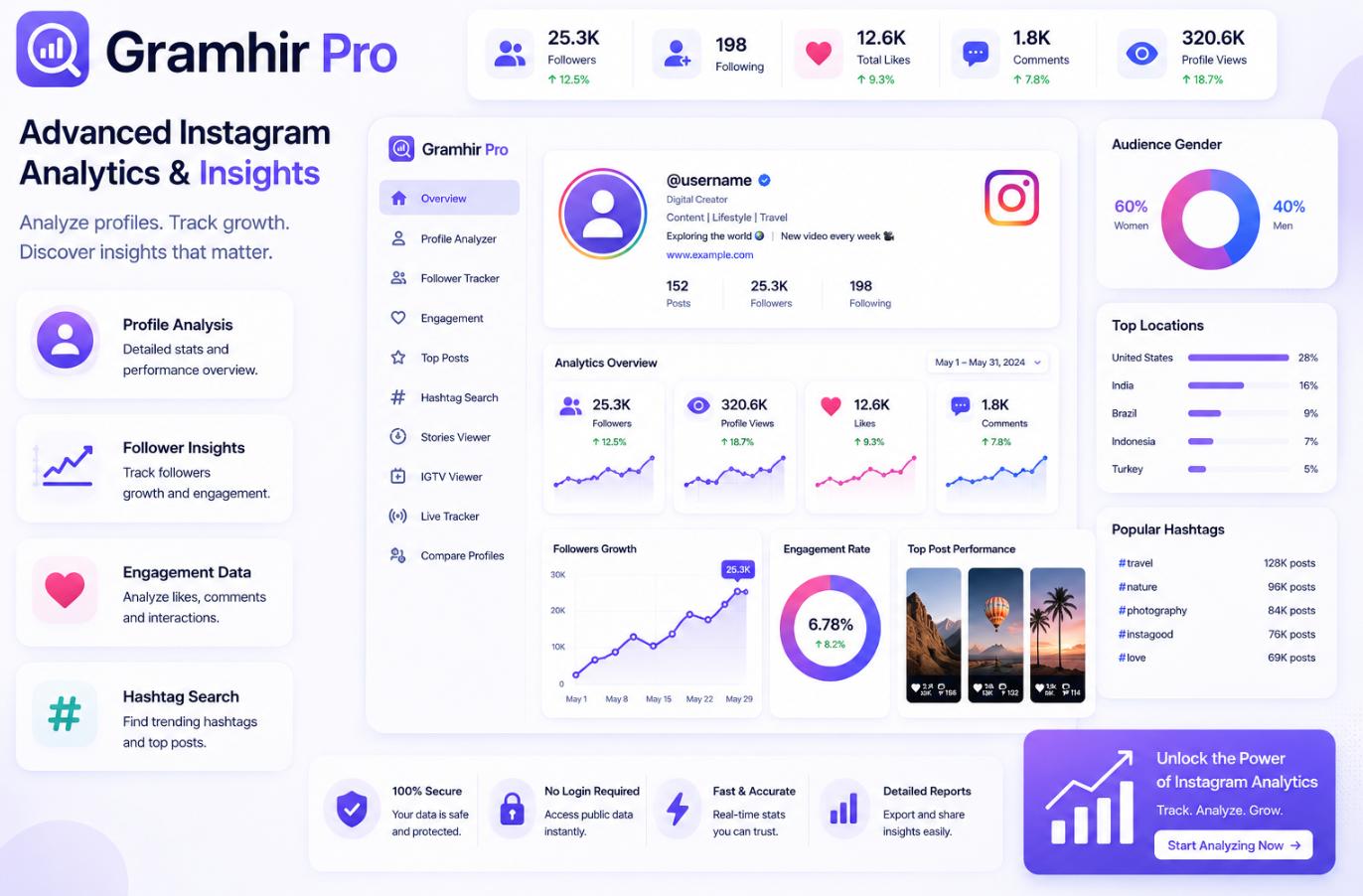
At its simplest, Gramhir Pro is a web-based Instagram viewer and analytics dashboard. Enter a public Instagram username, and it returns aggregated statistics about that account: estimated follower growth, engagement rate, average likes and comments, posting frequency, hashtag patterns, and a browsable feed of public posts and stories that the tool has indexed. Most of what it displays comes from the same public data any logged-in Instagram user can see; the pitch is that Gramhir Pro presents it in a cleaner analytics interface and, importantly, without requiring you to log in with your own account.
That last piece — no-login access — is what separates Gramhir-style tools from Meta’s own Insights, which is only available to the account owner. It is also what makes the category legally and technically fragile.
How this class of tool actually works under the hood
Understanding the mechanics matters because it explains both the strengths and the recurring failures of Gramhir Pro and its peers.
Instagram exposes public profile data through its web frontend and mobile app. Third-party viewers scrape or ingest that data using rotating IP pools, headless browsers, or reverse-engineered API endpoints that Meta does not officially publish. Once fetched, the data is normalised, cached, and served to visitors through the tool’s own interface. Analytics estimates — engagement rate, growth curves, best-time-to-post recommendations — are calculated on top of that cached data using conventional statistical methods, not any privileged data source.
Two consequences follow. First, the tool’s data is only as fresh as its most recent scrape of a given account. Popular profiles get refreshed more often; long-tail profiles may be stale. Second, the tool is inherently in a cat-and-mouse relationship with Meta. When Instagram tightens rate limits, changes markup, or blocks scraping infrastructure, third-party viewers break. Sometimes they come back within hours; sometimes features quietly disappear for weeks.
What Gramhir Pro is genuinely useful for
Within its limits, the tool covers a few practical use cases well.
Anonymous browsing of public profiles is the most obvious. If a Reddit thread references an Instagram account and you would rather not open the app, tools in this category let you view the profile without contributing to the visit signal Meta associates with a logged-in visitor. That is a privacy-preserving use case, and a legitimate one.
Competitive research for creators and small businesses is another. Comparing your own posting frequency and engagement rate against three or four competitor accounts — without needing to run a paid analytics platform like Social Blade Pro, Hootsuite, or Sprout Social — is a reasonable use of a free or low-cost viewer.
Story viewing without leaving a viewer mark is a use case some visitors care about, though it should be noted that Instagram itself occasionally updates its view-tracking behaviour, and third-party viewers do not always keep up.
Post-hoc account research also fits. Journalists, researchers, and moderators sometimes need to look at public accounts without contaminating their own tracked activity, and Gramhir-style tools provide a workable path when the more rigorous option — a research-approved API access — is not available.
What it is not good for
The same architecture that makes the tool useful also imposes hard limits.
Deep analytics on your own account is better served by Meta’s own Insights. The official tool has access to data no scraper can see — reach, impressions, follower demographics, non-follower interactions — because Meta simply does not expose that data through the public web. If you own the account, use Insights and treat third-party tools as supplements.
Access to private accounts is not a real feature, and any tool promising it is misrepresenting itself. Private-account data is not visible to logged-out scrapers because Instagram does not serve it publicly. Sites that claim otherwise are almost always either scams, phishing attempts, or wrappers around whatever the target has previously posted publicly.
Real-time monitoring is unreliable. Instagram’s rate limits and Meta’s anti-scraping measures mean any third-party viewer runs on delayed, potentially stale data. If your workflow requires knowing about a post the moment it goes live, this class of tool will not deliver.
The trade-offs worth understanding before using it
Every third-party Instagram tool carries a specific set of trade-offs. Being clear-eyed about them prevents surprises.
Terms of service. Meta’s terms explicitly prohibit unauthorised scraping and access to Instagram data outside its official APIs. Enforcement is inconsistent, and consequences typically fall on the operator of the tool rather than on individual users. Still, users who log into their own Instagram accounts through third-party interfaces face a real risk of account suspension. Gramhir Pro at least does not require you to log in with your Instagram credentials, which is the correct baseline. Any tool asking for your Instagram password should be treated as a phishing attempt.
Data legality. “Public” is not the same as “freely usable.” Scraped Instagram data is public in the sense that it is visible without authentication, but its use is constrained by the platform’s terms and by general data-protection law in jurisdictions like the EU and California. Personal or small-scale viewing sits comfortably in most people’s understanding of fair use. Commercial data extraction — building a database of scraped profile data, reselling analytics, training models on the data — sits in genuinely contested legal territory.
Privacy for the account being viewed. Even when a profile is public, most users have some intuitive expectation of context — they posted for their followers, not for a third-party analytics dashboard. Tools in this category flatten that context. That does not make them unusable, but it is worth remembering when the account you are researching is a real person rather than a corporate brand.
Freshness and reliability. As covered above, data can go stale without warning. Do not build workflows that assume Gramhir-style tools will be available or accurate on any given day.
Alternatives across the price and legitimacy spectrum
Depending on the underlying need, several alternatives may fit better than Gramhir Pro.
For your own account, the official options are always the correct starting point: Instagram Insights, the Meta Business Suite dashboard, and Meta’s Creator Studio. These have privileged access to your own data and no reliability risk from anti-scraping measures.
For competitive research at any scale beyond casual, established paid tools cover the space with proper agreements in place: Sprout Social, Later, Hootsuite Analytics, Social Blade, HypeAuditor for influencer vetting, and Modash for creator discovery. These cost real money but are contractually clear.
For anonymous browsing of a single account, an incognito or private browser window remains effective for most public profiles, and platforms like Picuki and Imginn have long served this niche. Bear in mind that any of these tools may be up one day and down the next — the category has an unusually short life-cycle.
For story viewing specifically, several standalone tools exist, though they change more often than any evergreen article can track. The safe rule is to check that the tool does not require login and reads only public data.
FAQ
Is Gramhir Pro safe to use?
Using the tool as an unauthenticated viewer — no login, no personal data entered — carries roughly the same risk as any other unfamiliar website: mainly around tracker load and ad quality. Do not log in to any Gramhir-style site with your Instagram credentials. That is the single most important safety rule for the category.
Can Gramhir Pro show private accounts?
No. Private accounts are private because Instagram does not serve their content to unauthenticated requests. Any site claiming to bypass this either does not work, works only against accounts that were briefly public in the past, or is running a scam to collect credentials.
Will using it get my Instagram account banned?
Merely viewing public profiles through a third-party viewer is unlikely to result in action against your account, because you are not logged in and not linked to the activity. Logging into your Instagram account through any third-party wrapper is a different matter and is against Meta’s terms.
How accurate are the analytics?
Directional rather than exact. Engagement rate, growth curves, and posting frequency estimates from scraped public data can be usefully accurate for competitive research, but they do not match what the account owner sees in Instagram Insights, and they lag reality by hours to days.
Does the account I’m viewing know I looked?
For posts, no — Instagram does not report post-view identities publicly. For stories, the behaviour depends on whether the viewer is authenticated on Instagram’s side. Unauthenticated scrapers do not appear in story viewer lists, but this behaviour has changed in the past and could change again.
A working conclusion
Gramhir Pro is a functional entry in a category that has always been useful and always been fragile. For casual profile viewing, informal competitive research, and anonymous browsing of public accounts, it does what it says. For anything mission-critical, anything commercial at scale, or anything involving your own account’s analytics, better options exist — some free from Meta, some paid from established analytics vendors. The right way to place the tool in a workflow is as a convenience, not a foundation.