Infinite Craft Unblocked: How the Game Works and Plays Best
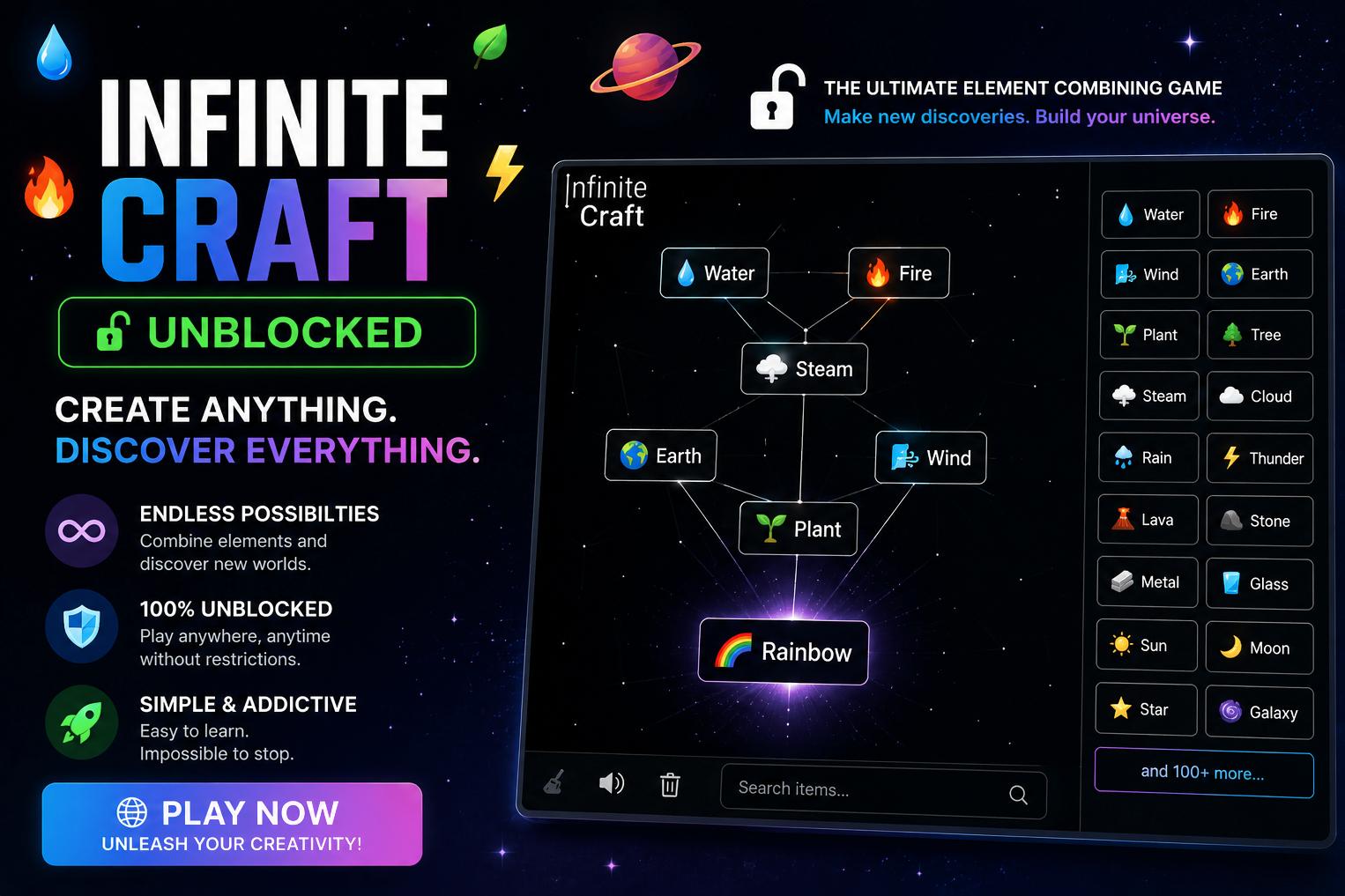
Infinite Craft, released on Neal Agarwal’s neal.fun in early 2024, is one of those browser experiments that became a cultural moment because of a single design choice: the game uses a large language model to generate new elements when you combine existing ones. Instead of a fixed recipe list, the entire content of the game emerges from what the model decides is a plausible fusion of two things. The result is a game where combining “Water” and “Fire” gives you “Steam,” combining “Steam” and “Wind” gives you “Cloud,” and combining “Cloud” and “Dragon” gives you something the game invents on the spot. It also explains why the search behaviour around “Infinite Craft unblocked” is unusually strong: the game is free, browser-based, and endlessly self-generating in a way that keeps students returning across days and weeks.
What Infinite Craft actually is
The game is a single web page. On the right side is a list of elements you have discovered, starting with four base elements: Water, Fire, Wind, and Earth. On the left is a large empty canvas where you drag elements to combine them. Dropping one element onto another triggers a combination — the game calls out to a language model on the backend and returns whatever the model believes those two things fuse into. The result becomes a new element added to your discovery list.
The interface is intentionally minimalist. There is no score, no level system, no time pressure, no fail state. The only game loop is discovery: what happens when I combine these two things? The game rewards curiosity by producing surprising, occasionally poetic, occasionally absurd results, and the community shares the more interesting discoveries widely.
What makes it a specifically 2024-onward creation is the underlying model. Earlier alchemy-style browser games — Little Alchemy and its sequel are the canonical predecessors — worked from a hand-authored recipe database. Infinite Craft skips the hand-authoring entirely; the model is the recipe book, and its answers evolve as the model itself updates.
The specific mechanics under the hood
Understanding a little about what happens when you combine elements sharpens the play experience.
When you combine two items, the game sends the pair to a backend service running a language model, which returns two things: the name of the resulting element and an emoji representing it. The result is deterministic — the same pair always produces the same result — which is important because it lets combinations replicate across players. Two people combining “Cheese” and “Moon” get the same output, which makes the shared discovery culture around the game possible.
The model is not free of biases in what it returns. Certain kinds of combinations tend to produce certain kinds of results. Simple physical fusions get physical outputs. Fusions of concept-heavy elements (“Philosophy” plus “Fire,” for example) get abstract or metaphorical outputs. Named entities — historical figures, characters from fiction — get pulled in when the fusion suggests them.
The result is that the game plays differently depending on where you push it. A player chasing physical elements (“Wind” plus “Steam” plus “Ice” plus “Salt”) ends up in a very different discovery tree than a player pushing into abstract territory (“Idea” plus “Doubt” plus “Silence”).
Practical discovery strategies
Players who spend real time with Infinite Craft eventually converge on a small set of habits that produce more interesting output.
Combine unlike things deliberately. The most surprising results usually come from pairings the model does not have an obvious recipe for. Predictable combinations produce predictable results; unusual ones produce interesting ones.
Follow one branch deeply before branching out. Combining a specific element repeatedly with a range of others often produces a rich cluster of related discoveries. Jumping around randomly produces breadth but not depth.
Notice when the game repeats elements. Some combinations produce results you have already discovered. This is not a bug — it is a signal that the model considers those two things similar enough to converge on the same output. Noticing convergence points helps you understand the shape of the underlying semantic space.
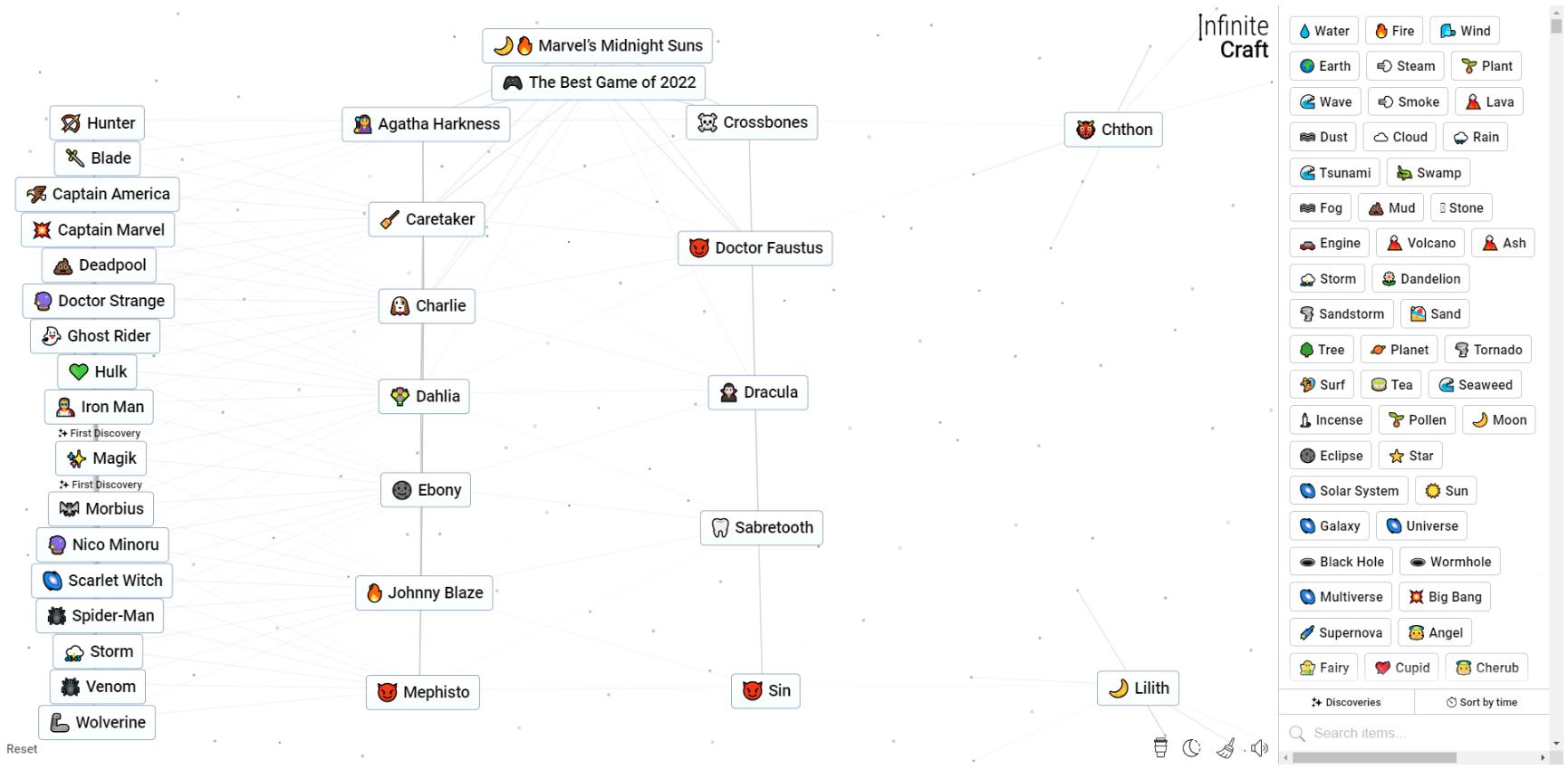
Use First Discoveries as a landmark. The game marks results that no other player has previously discovered with a specific badge. Chasing First Discoveries is one of the more meta-gamed play patterns and is why obscure combinations circulate through the community.
Try named-entity combinations sparingly. Combining people’s names or fictional characters produces entertaining but sometimes strange results. Some players find this the most interesting part of the game; others prefer to stay in the abstract-element space. Neither is wrong.
The unblocked-browser question
Infinite Craft is hosted at neal.fun and does not require any account, installation, or age gate. That is the primary source of the “unblocked” search behaviour: users looking for a browser game they can play at school and finding one that is fully hosted at a single well-known independent-web address.
Whether neal.fun is blocked in a specific school district varies. Some districts categorise it as gaming; others do not. When it is blocked, mirror sites and proxies emerge to route around the block, following the same pattern as other unblocked-games ecosystems. The mirrors that host or proxy Infinite Craft face a specific technical challenge — the game requires a backend API call for each combination, so a static mirror cannot replicate the game; only sites acting as full proxies to the actual neal.fun backend work.
For users who reach the game legitimately at neal.fun, no additional setup is required. Bookmark, play, discover.
Why the game feels different from most browser games
Several features distinguish Infinite Craft from other quick browser games that get grouped with it.
There is no session end. Games in this space usually have a run structure — start, play until fail, restart. Infinite Craft has no fail state, and the run is theoretically infinite. That changes the emotional shape of playing it. Sessions end when you decide to stop, not when the game decides.
Discoveries persist. Every element you have found stays in your list across sessions, browsers permitting. The game rewards long-term engagement in a way that ephemeral browser games do not.
The output is genuinely novel. Because a language model is generating each combination, the game surfaces results the developers themselves have never seen. That is a specific kind of design decision — one that relinquishes control of the output in exchange for endless variety.
The community layer is unusually rich. Players share screenshots of specific combinations, chains of discoveries that lead to specific outputs, and First Discoveries they have made. TikTok, Reddit, and Twitter/X carry active Infinite Craft content in a way that most casual browser games do not sustain.
The kinds of discovery trees players end up building
After enough time in the game, most players notice that their element list has a specific shape. Some players end up with hundreds of physical and natural elements — stone, wood, iron, forest, river, mountain — reflecting a bottom-up worldbuilding tendency. Others end up with a strange mix of abstract concepts and named entities — Democracy, Regret, Napoleon, Chaos — reflecting a top-down interpretive approach. Others build sprawling absurdist trees where “Sandwich” begets “Sentient Sandwich” begets “Sandwich Empire,” reflecting a comedic engagement with the model’s willingness to iterate on themes.
None of these tendencies is wrong; the game is designed to accommodate all of them. Noticing which tendency dominates in your own play is a small piece of self-observation that makes subsequent sessions more deliberate.
Adjacent tools and derivative work
Infinite Craft’s premise has inspired a small ecosystem of similar tools. Some are direct clones with different underlying models; some experiment with variations on the concept — combining images instead of text, adding scoring systems, layering constraints on the output. None have matched the specific viral hit that Infinite Craft became, but the design pattern is now visible across other independent web projects.
For players who exhaust Infinite Craft’s specific version of the mechanic, exploring these derivatives is worth the time. Each brings a slightly different set of constraints and outputs, and the differences illuminate what specifically made the original work.
A brief note on Neal Agarwal’s wider work
Infinite Craft did not appear in a vacuum. Neal Agarwal has run neal.fun for years as a personal experimental site, home to a large catalogue of small interactive projects — the Deep Sea explorer, Absurd Trolley Problems, Password Game, Design the Next iPhone, Stimulation Clicker, and many others. Each is a self-contained curiosity, and the site collectively represents one of the more interesting bodies of independent-web work of the last decade.
Players who enjoy Infinite Craft will likely enjoy the wider neal.fun catalogue, and the site is a good example of what personal-project independent-web work can produce when a single creator has consistent taste and technical ability. It is also a good reminder that not every meaningful piece of software comes from a company; some come from individuals pursuing their own curiosity in public.
A short close
Infinite Craft is a specific product of a specific moment — a moment when running a language model behind a simple browser game became cheap enough to make the design feasible. That combination of low-cost intelligence and minimal interface produced a genuine cultural artefact, and the game continues to attract new players years after release. Anyone searching for it in browser form should reach for the original at neal.fun rather than a mirror, treat the game as the discovery loop it is rather than a completion challenge, and let the model surprise them. The best experience is the one that starts with curiosity and does not stop until the curiosity does.