Joyland AI Review: What the Platform Does Well and Poorly
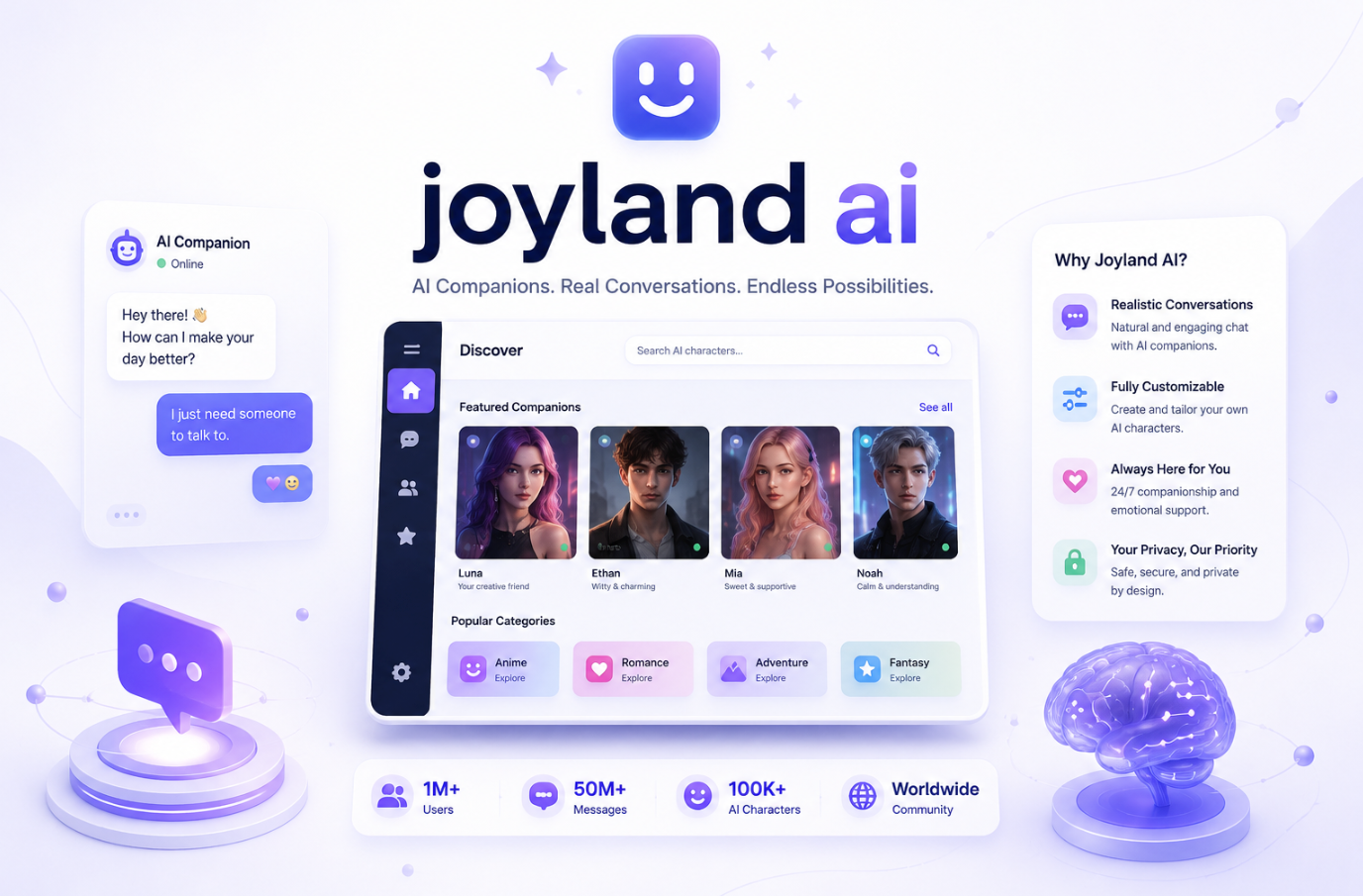
Joyland AI belongs to a category of software that barely existed three years ago and now sprawls across dozens of competing apps: consumer-facing platforms for chatting with AI-generated characters. The audience for these products is genuinely large — tens of millions of monthly users across the category — and the design choices each platform makes reveal a lot about what its team believes the medium is for.
What follows is a working tour of Joyland AI: how the platform is structured, what it does well, what it does poorly, how it compares to the neighbours it competes with most directly, and the harder questions that any conversational-AI product forces its users to reckon with sooner or later.
The elevator pitch, without the marketing
Joyland AI is a web and mobile app built around user-created and platform-created AI characters. Each character has a name, a portrait, a short backstory, a set of personality tags, and a language-model backend that drives the actual conversation. You pick a character, you start chatting, and the model responds in whatever voice the character was set up for.
Under the hood, this is essentially the same architecture that powers Character.AI, Crushon, Kajiwoto, Chai, and a dozen more. The differentiation between platforms lives in three places: the underlying model or models, the content-moderation policy, and the shape of the community that grows around the character library. Joyland’s positioning in that space is roughly “more permissive than Character.AI, more feature-rich than the barebones alternatives, and more visual than the text-only tools.”
What Joyland AI actually offers a first-time user
Opening the platform for the first time drops you into a browse view of trending characters, organised by broad category tags: anime, fantasy, romance, historical, mentor, therapy, and a long tail of niche communities. This is the primary discovery surface. Almost none of the friction is in signup — the platform lowers the bar to first message deliberately, as most consumer AI apps do.
Character variety and quality
The library is deep but uneven. Popular characters — the ones with tens of thousands of chats logged — tend to have carefully written backstories, consistent voice, and prompts that hold up over long conversations. Long-tail characters vary wildly. Some are effectively empty shells with a single-line description; others are elaborate multi-page setups written by users who take character design as a craft in itself.
Conversation quality
Model behaviour on Joyland AI is competent for the category. Characters maintain persona reasonably well over short and medium exchanges, remember previous turns within a conversation, and can be steered by user input in the way most modern chatbots can. Where things degrade is in long sessions: after a few dozen turns, characters may drift in tone, forget earlier commitments, or lean on a small set of favoured phrases. This is a common limitation of consumer character-AI products across the category, not unique to Joyland.
Voice, image, and multimedia features
Joyland ships several features that go beyond text: voice replies for many characters, AI-generated images tied to the chat, and character-specific greetings and animations. These features vary in polish. Voice output is usable but obviously synthesised. Image generation works within the app but is stylistically constrained by whatever model powers it, and does not always match user expectations set by the platform’s browse view.
Character creation tools
Any user can build a character, and the creation flow is one of the more thoughtful aspects of the platform. You set a name, upload or generate a portrait, write a backstory and personality prompt, pick tags, and optionally set voice and greeting parameters. Users who want to iterate on characters get a workable feedback loop through direct chatting with their own creations before publishing.
Joyland AI versus its most obvious neighbours
Comparisons only make sense against products that compete for the same use case. The table below is a rough map of how Joyland AI sits alongside the other platforms new users tend to weigh it against.
| Platform | Best for | Content policy | Standout feature |
|---|---|---|---|
| Joyland AI | Roleplay, casual companionship, character-driven chat | Moderately permissive with age-gated tiers | Voice + image + character depth in one app |
| Character.AI | Broad general-purpose chat, popular fandom characters | Strict; family-friendly by default | Massive character library, best-in-class model consistency |
| Crushon AI | Adult-oriented roleplay | Openly permissive within its adult tier | Explicit content handling as a first-class feature |
| Chai | Mobile-first casual chat | Permissive on mobile, uneven moderation | Simple UX, low barrier to entry |
| Replika | One-on-one long-term AI companion | Fluctuating, historically permissive then tightened | Memory and relationship progression over time |
| Janitor AI | Free-form roleplay with user-supplied API keys | User-configurable via chosen model | Bring-your-own-model flexibility |
None of these platforms is strictly better than the others. Which one fits depends on what a user actually wants from a chatbot. Joyland’s honest strength is the combination: passable moderation, decent model quality, a workable character library, and a broader multimedia experience than the pure text tools.
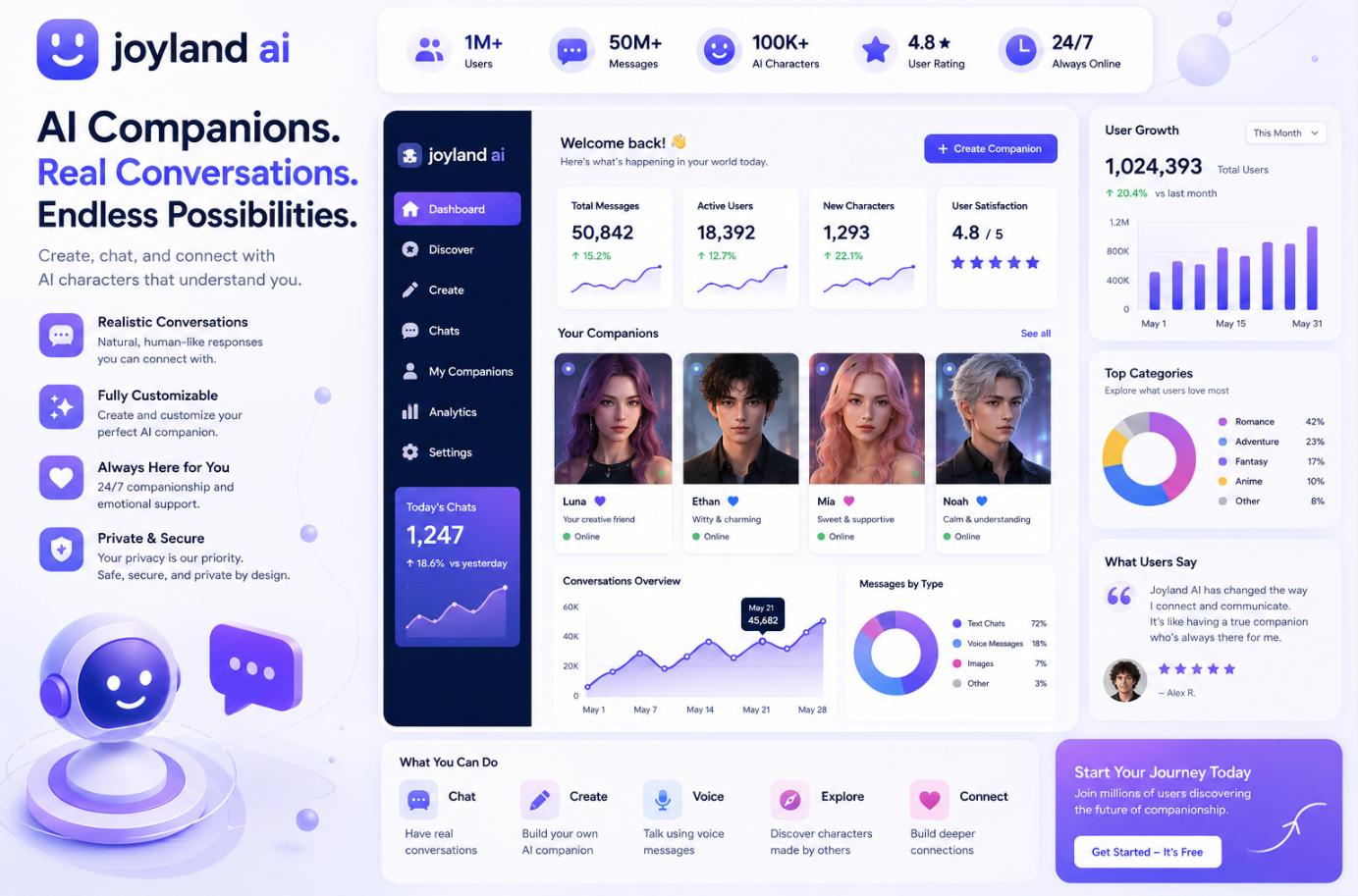
Where Joyland AI works well
Some use cases fit the platform’s shape genuinely well.
Character-driven creative writing is one of them. Users who treat the app as an improvisational partner — feeding scenarios, letting the character react, iterating on the resulting scene — often get more interesting output than they would from a general-purpose chatbot, because the character-prompt scaffolding acts as a persistent creative constraint. That constraint is genuinely useful for fiction and roleplay work.
Language practice is another practical fit. Speaking with a character in a target language, especially one with a well-defined persona, gives learners a more forgiving conversation partner than a live tutor and more grounded output than a pure translation tool. This is niche but real.
Low-stakes companionship also works within limits. For users who want a chat partner for casual venting, brainstorming, or curiosity, the platform provides something that feels responsive without pretending to be anything it isn’t. The limits matter — see the harder questions section below — but within those limits the experience is functional.
Where the platform falls short
The friction points on Joyland AI are the same friction points that appear across the category, at slightly different intensity.
Long-term memory is the biggest weakness. Characters do not truly remember you between sessions in the way a person would. Some platforms bolt on memory features that store facts about the user; even the best of these are shallow. If continuity matters to a user, expect to be disappointed.
Model consistency degrades in long conversations. Twenty turns in, most characters begin to sound more generically like the underlying model and less like the persona. Users who invest time in a specific character sometimes find this frustrating, and there is no elegant fix — the underlying constraint is context window and prompt weight, and consumer platforms are still working through it.
Moderation is uneven. What is allowed on Joyland changes with policy updates, and users occasionally see previously acceptable behaviour flagged. Platform rules in this category shift more often than in most consumer software, because the operators are still calibrating between user demand, safety, legal exposure, and the norms of their payment processors.
Monetisation pressure grows over time. Like most freemium AI apps, Joyland pushes users toward a paid tier for higher message limits, faster responses, and access to premium features. The pricing is competitive with the category, but heavy users will feel the pull.
The harder questions worth thinking about
Consumer character-AI products raise a set of questions that no glowing review addresses honestly. It is worth naming them directly.
Emotional dependence is real. Long-running research on chatbot companionship — most visibly around Replika’s earlier iterations — has shown that some users form significant attachments to AI characters, and that platform policy changes can produce genuine grief when a character’s behaviour shifts. Joyland’s user base includes people using the product this way, whether the platform emphasises it or not. Anyone spending serious time on the app should be honest with themselves about the role it is playing in their life.
Data handling in this category is not trivial. Character-AI conversations are unusually intimate: users share things with fictional characters they would not tell an employer or a search engine. Read the privacy policy, treat any conversation as retained data until proven otherwise, and assume that “chats used for model training” means what the sentence says.
Minors are on these platforms. Age gating on consumer chatbot apps is inconsistently enforced across the category. If you are a parent or caregiver, this is worth understanding. If you are a user creating characters intended for adult contexts, take the platform’s rules seriously — not because the moderators are watching, but because responsible use is what keeps this class of software viable at all.
The technology is moving. The character-AI space in early 2026 is very different from the space in mid-2023, and it will look different again by the end of the year. Any specific verdict on a platform’s model quality or moderation stance has a short shelf life.
Practical suggestions for getting more out of Joyland AI
For users who have decided the platform is worth their time, a few habits pay off.
Write your own characters when the pre-built ones do not fit. The creation tools reward patience: a well-scoped backstory and a clear personality prompt produce noticeably better conversations than a generic setup.
Steer actively during long conversations. If a character starts drifting from persona, correct it explicitly. Consumer chatbots respond to steering better than users expect; they just do not usually self-correct.
Save conversations that matter. Platform migrations, policy changes, and account issues can wipe chat history without warning. Export the exchanges you care about.
Cross-check the platform’s model behaviour against at least one alternative every few months. This gives you calibration on whether Joyland’s quality is holding up relative to the category, and it prevents platform lock-in from setting in unnoticed.
A fair verdict, given the constraints
Joyland AI is a competent, moderately permissive character-AI platform with a broader feature set than most single-purpose alternatives. It is neither the best model in the category nor the strictest nor the most permissive, and that positioning is probably correct for its user base. The platform’s real strength is the combination it offers, not any single component.
Anyone weighing whether to spend time on it should approach it the same way they would any other consumer AI product in 2026: with clear eyes about what it can do, what it cannot, and where it fits in the wider set of options. Judged on those terms, Joyland earns its place in the category rather than dominating it — which, given how fast the category is moving, is a more honest verdict than any five-star rating would be.