Make1m.com: How to Read the Make One Million Genre Honestly

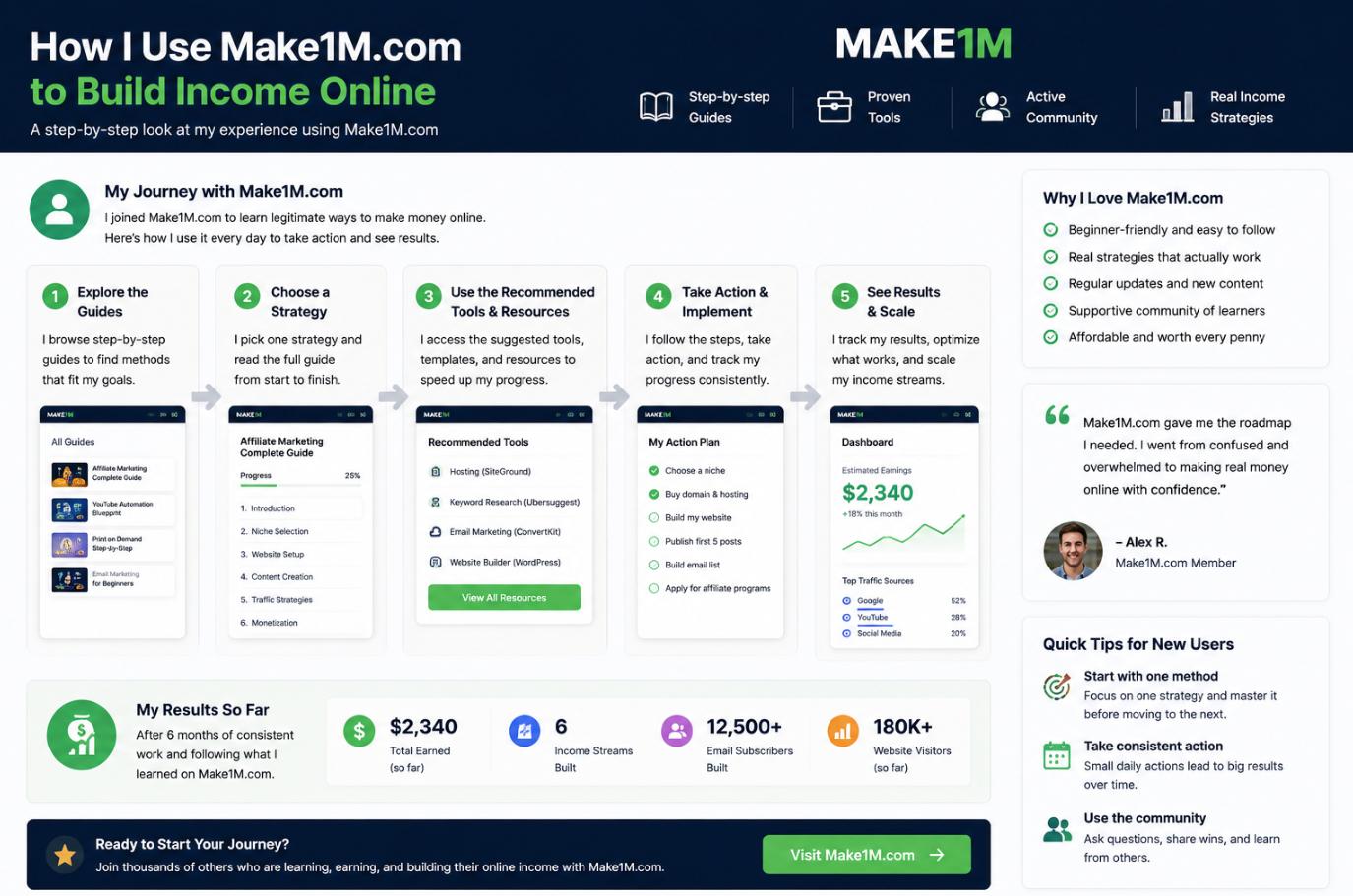
Sites in the “make one million” genre exist because the underlying search demand is huge and the cost of standing one up is close to zero. make1m.com sits inside that genre, and the useful way to think about it is not as a lone site to be evaluated in isolation but as one member of a well-defined category of financial-content websites that share a small number of characteristic patterns. Understanding those patterns tells you more about what to expect from make1m.com than any single review would.
The genre make1m.com belongs to
The “how to make a million dollars” corner of the internet has three roughly distinct traditions, and any specific site is usually a mixture of the three.
The first is legitimate financial literacy content. Long-running personal finance publications — The Simple Dollar in its editorial heyday, NerdWallet, Money Under 30, ChooseFI’s site — cover saving, investing, tax efficiency, retirement modelling, and business building in ways that stand up to scrutiny. Their advice tends toward the boring: index funds, compound interest, tax-advantaged accounts, small-business fundamentals, disciplined saving over long periods. There is nothing get-rich about it; the underlying model of wealth building takes decades.
The second is the get-rich-quick tradition. Sites promising specific returns, guaranteed methods, or fast paths to seven figures without proportional risk. This tradition has been a fixture of financial media since long before the internet, and it has adapted efficiently to online distribution. The characteristic tell is precision without accountability — very specific promised outcomes (“$10,000 per month starting month one”) paired with vague or missing detail on how those outcomes were achieved by the site’s actual operator.
The third is content-marketing sites that exist primarily to route traffic to affiliate offers. Their editorial content is real, their advice is often reasonable, but their business model is affiliate revenue from crypto brokers, trading platforms, high-yield savings accounts, investing courses, credit cards, or business tools. Nothing about affiliate-funded content is inherently disqualifying, but readers deserve to know they are inside a marketing surface as they consume it.
make1m.com’s actual mix of these three is what determines how useful it is to any given visitor. Reading the site through that lens is more productive than looking for a single verdict.
A short vocabulary for evaluating any make-money site
Some terms turn up so frequently in this genre that they are worth defining precisely, both because they signal what the site is doing and because they mean different things than casual usage suggests.
- Passive income
- Technically, income that requires no active work to sustain once established. In practice, most content marketed as “passive” involves substantial upfront work and ongoing maintenance. When a site uses the term without qualifiers, treat it as a genre marker rather than a technical claim.
- Side hustle
- Loosely, any income-generating activity outside a primary job. The term ranges from freelance work with a real market rate to schemes that consume more time and money than they return. Whether a specific “side hustle” article is useful depends entirely on the honesty of its economics section.
- Financial freedom
- Marketing language for having enough passive income to cover living expenses. The concept is real (see the FIRE movement — Financial Independence, Retire Early — with its 4% rule and specific savings targets), but many sites use “financial freedom” as an emotional trigger rather than a defined goal.
- Wealth-building
- Broad umbrella term for accumulating assets over time. On serious sites, means investing, business building, and tax strategy. On get-rich sites, often means whatever the current affiliate offer is.
- Compounding
- Genuine mathematical phenomenon — returns generating returns over time. A site that discusses compounding with real assumptions, honest fees, and multi-decade time frames is doing legitimate work. A site that mentions compounding to justify aggressive short-term promises is not.
Signals worth reading on make1m.com specifically
The following pass is worth running on make1m.com — and on any similar site — before spending real time inside its content.
- Check the author bylines. Real financial writers have careers you can look up. Fake ones do not. If articles are unsigned, signed by first names only, or signed by names that produce zero relevant search results, the site is not committing to editorial accountability.
- Look for realistic economics. Legitimate money content shows work: assumed rates of return, time horizons, tax treatment, fees. Content that mentions only headline outcomes (“I made $X”) without the mechanics is marketing, not analysis.
- Identify the monetisation model. Every content site has one. Ads, affiliates, courses, coaching, subscriptions. None are automatically bad. All should be visible without hunting.
- Read the disclosures. FTC guidelines require affiliate relationships and paid promotions to be disclosed. A disclosure page that reads honestly is a strong signal. A missing or evasive one is a weaker signal in the other direction.
- Compare specific claims against outside sources. Any concrete claim — a specific broker fee, a tax rate, a return figure — should reconcile with independent references. Sites that misstate widely knowable numbers often misstate less-checkable ones too.
- Check the archive. A site that publishes consistently over years, corrects mistakes, and updates old content is running a real operation. A site with a burst of recent posts and no history is either brand new — in which case it deserves patience — or a rebrand from something that did not survive.
What legitimate wealth-building content actually looks like
For readers who arrived at make1m.com hoping to learn how to build real long-term wealth, a short calibration on what serious content in the space actually says is useful.
The mainstream US path to $1 million in net worth — the closest thing to a boring, boring but boring true answer — involves a combination of consistent saving into tax-advantaged accounts (401(k), IRA, HSA, employer match), broad low-cost index investing (Vanguard, Fidelity, Schwab three-fund portfolios), disciplined lifestyle inflation management, and time. Under conservative return assumptions (6-7% real, well below what marketing content usually cites), the numbers work over 20 to 30 years for a wide range of income levels.
The complementary approach — small-business ownership, real-estate ownership, professional advancement, high-earning skills development — accelerates the timeline at the cost of increased effort, risk, and concentration. Every real path to a million has both an income side and an investment side, and content that emphasises one to the exclusion of the other is telling half the story.
None of this is exciting. None of it lends itself to daily blog posts, monthly newsletters, or aggressive email marketing. Which is precisely why “make one million” content on the internet skews so heavily toward less-boring-but-less-effective claims.
A short list of alternatives worth using directly
Depending on what a reader actually wants from a site like make1m.com, several alternatives cover the space more reliably.
- For personal finance fundamentals: the r/personalfinance wiki (Reddit), Bogleheads.org, and the podcasts and posts around ChooseFI cover the core mechanics thoroughly and for free.
- For investing specifically: Morningstar’s free research surface, official prospectuses for index funds, the annual reports of any broker you use.
- For tax and retirement account strategy: the IRS’s own publications on 401(k) limits and IRA rules, and books like Michael Kitces’s blog posts and Kevin O’Reilly’s tax primers.
- For business building: the free content from Y Combinator, the writing of Josh Kaufman (The Personal MBA), and the industry-specific communities on Indie Hackers and MicroConf.
- For financial-independence goal setting: The FIRE community’s calculators, savings-rate discussions, and the annual updates from Mr. Money Mustache and similar long-running writers.
A quick note on how to actually read a “success story” post
Case-study posts — someone claims to have reached a specific income milestone through a specific method — are a recurring feature of make-money sites. They deserve their own reading protocol. First, treat the numbers as marketing until you see a source. Second, check whether the story’s timeline is proportional to what the method would realistically produce; a claim of “$1M in eighteen months” from ordinary content marketing is not compatible with observed base rates in the industry. Third, look for what the author is selling underneath the story. A success post that leads to a coaching program, a course, a Patreon, or a paid newsletter is subject to a specific incentive structure that shapes the retelling. Fourth, cross-check whether the author’s public presence — LinkedIn, professional accreditation, tax filings for cited entities where public — matches the claim’s scale. Most success stories that read as too good to be true are stories that would not survive that cross-check.
A working stance on make1m.com and the wider genre
The reason “make one million” sites keep appearing is that the underlying question — how do I move from where I am to real financial security — is one of the most important questions people ask. The reason so many of these sites disappoint is that the honest answer to the question is unglamorous, slow, and mostly about consistency across decades. That mismatch between what readers want to hear and what actually works keeps a large industry of intermediate sites in business.
make1m.com should be read the way any site in this genre should be read: with the checklist above active, with the vocabulary above in mind, and with an awareness that better resources exist for anyone who wants to move from motivation to method. The genre serves a role — motivation is not nothing — but the actual work of building wealth happens somewhere else. Readers who are clear about which they are seeking on any given visit will get more out of every site they open, make1m.com included.