Survival Race Unblocked: What Makes the Game Actually Work
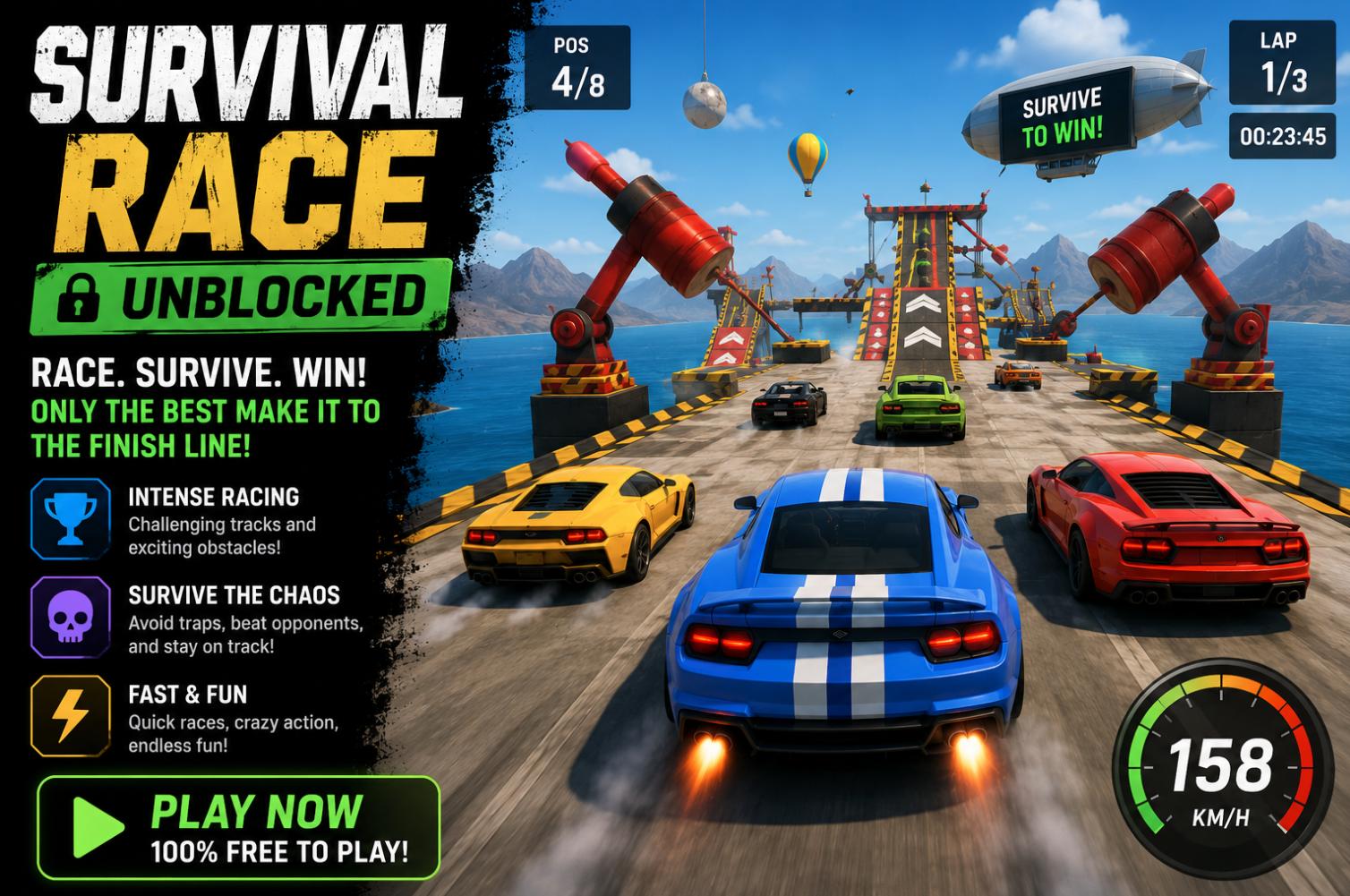
Survival Race is the kind of browser game whose name is almost the entire pitch. A track. Obstacles. A car or a runner. A finish line at the other end. A specific mechanic that turns the standard racing formula into something with tension: the player is not just trying to be fast but is trying to stay alive on a course that has been designed to remove them from it. It is a small, casual, mechanical game — deliberately shallow, deliberately replayable, and consistently one of the more-searched titles on unblocked-games portals for reasons this piece walks through.
What the game actually is
Several games have used the “Survival Race” title or something very close to it, and the specific game a player reaches from a search may be one of a handful of variants. The most common form is a browser-based obstacle race in which the player controls a car (occasionally a runner) through a course strewn with hazards — obstacles that ram, drop, or crush the player, gaps that must be jumped, and other racing traffic that acts as both competitor and obstacle. Speed is a variable the player can influence but not always control precisely. The game rewards a specific mix of aggression and caution that the player has to calibrate through repeated runs.
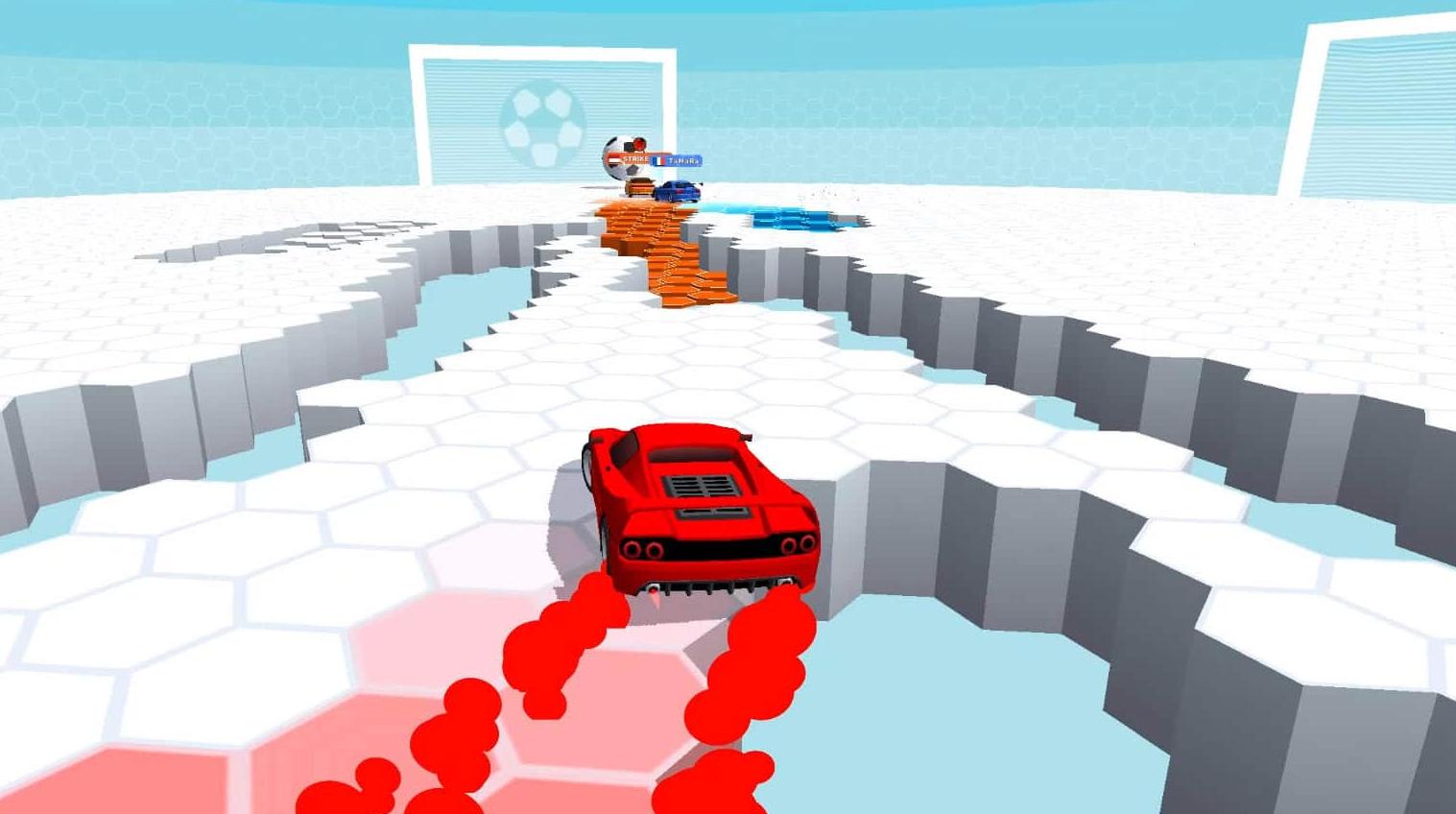
The visual style tends to be blocky and stylised rather than realistic, in the tradition of casual browser racers from the last decade. The physics are usually forgiving enough to allow last-second recoveries, which is important — a game that punished small errors severely would produce frustration rather than the replay-friendly frustration the genre thrives on.
Why the design rewards replay
Casual browser games in this specific corner survive on repeat play. Survival Race’s design accommodates that on several axes at once.
Runs are short. A typical attempt takes under two minutes, either ending in a finish or in a survival-ending obstacle collision. That length fits into fragments of time — between assignments, at a lunch break, in the last few minutes before dismissal — that longer games cannot use.
The failure mode is instant and specific. Instead of running out of health slowly, the player crashes into something and is gone. That specificity produces clear feedback: I hit that ramp, that jump was too fast, that car came into me on the corner. Clear feedback drives learning, which drives improvement, which drives return sessions.
Recovery is fast. A crash puts you back at the start (or at a recent checkpoint) in seconds. Games with slow restarts kill their own replay loops; Survival Race, in most of its versions, keeps the loop tight.
Progression is visible run over run. Beating your own previous distance or lap time in a specific race produces a small satisfaction that keeps players engaged past the point where the raw novelty has worn off.
The best casual games are not the ones with the deepest mechanics; they are the ones that get out of the player’s way and let short sessions accumulate into something that feels like progress.
What actually helps you finish more runs
For players who want to spend less of their time crashing and more of their time finishing, a small set of habits pay off.
- Slow down before difficult sections, not during them. Most racing games in this style let you brake into an obstacle-heavy section, take a moment to see what is coming, then accelerate through the clearer stretch after.
- Learn the track. Runs feel random the first three times through and start feeling deterministic by the tenth. Memorising specific obstacle positions is the single biggest source of improvement in this kind of game.
- Do not always try to be first. In a survival race, finishing is more important than winning any specific race. Choosing a slightly slower line that avoids a known hazard beats choosing the fastest line and crashing.
- Use the physics rather than fighting them. Most casual racers have specific quirks — where the car handles well in the air, where drift restores traction, where jumps land more forgivingly. Playing to those quirks feels better than fighting the game’s own logic.
- Take breaks after bad runs. Emotional tilt produces more crashes than technical error does. Two minutes off the game after a frustrating streak recalibrates the reflexes.
The unblocked-browser context
Survival Race sits in the wider unblocked-games ecosystem for the same reasons other browser casual games do: it is free, browser-hosted, uses no login, requires no installation, and delivers a satisfying short session with almost no setup. Portal sites bundle it alongside Slope, 2048, Cookie Clicker, and the rest of the casual-racing family.
Playing it through an unblocked-games mirror produces the standard risks of that ecosystem — aggressive ads on lower-quality mirrors, occasional prompts to install extensions or accept notifications, and adjacent content on some portals that is not appropriate for younger users. The safety habits that apply to any unblocked-games site apply here: do not log in, do not install anything, decline notification prompts, and use a browser with ad-blocking enabled.
For users who reach the game through a well-maintained portal, the experience is generally clean. The game itself is stable, the runs are quick, and the failure mode is fair. It is one of the harder casual browser games to break, which is worth something.
Where Survival Race sits in the casual racing tradition
Casual browser racing is one of the older categories on the web. The tradition runs from Miniclip’s early Flash-era hits through the Kongregate golden age, into the current HTML5 generation. Survival Race sits inside that continuity — building on formulas that go back years, adapting them for a different rendering technology and a different distribution model, but preserving the core loop that has always worked.
Related games in the current space include Slope (an endless-runner variant), Drift Boss (a physics-focused variant), Moto X3M (a stunt-focused variant), and various endless-highway games. Each carries a distinct twist on the same underlying reflex-and-timing loop. Players who enjoy Survival Race often rotate between several of these across the same session.
The specific niche Survival Race occupies is the “traffic and terrain” corner of the space — where the challenge is not just the track but the other vehicles and the specific obstacle placements. That combination gives the game its distinct feel against pure endless-runners or pure physics-toys, and it is why the title has retained an audience across the years since it first appeared.
Notes for anyone using the browser space
For any browser game reached through an unblocked-games portal, the underlying advice is the same. Play the game itself; ignore the surrounding portal machinery. Do not log in anywhere the game does not require it. Do not click any prompt that appears between the portal and the game. Close the tab when you are done.
Survival Race is a specific example of a game that works well through this ecosystem because its own scope is contained. The player is not building persistent state, syncing to a cloud service, or maintaining an account. Each session is complete in itself, and each session can end without ceremony. That contained quality is a design virtue in the specific context of browser-based casual gaming, and it is why the game has aged as well as it has.
Variants and adjacent titles worth trying
Players who exhaust Survival Race often gravitate toward specific adjacent titles. Slope offers a similar reflex loop with pure-momentum physics rather than traffic. Moto X3M pushes the stunt element harder. Drift Boss inverts the pattern, making handling the whole game rather than one element of it. Traffic Rider on mobile and various endless-highway browser variants extend the “avoid the cars” pattern in different directions.
Cycling between these titles across a session keeps the reflexes fresh and prevents the specific muscle memory of any single game from becoming a limitation. Casual browser racers reward variety at the level of session composition more than at the level of any single game’s depth.
Why this specific corner of gaming persists
A useful bit of reflection on Survival Race and its peers is why the entire casual-browser-racing category has stayed relevant across so many technology shifts. Flash gave way to HTML5; distribution moved from portal sites to social networks to mobile; graphics improved by orders of magnitude; input methods proliferated. Through all of that, casual racing has stayed.
The reason is that the underlying loop — quick reflex challenge, clear failure state, fast restart, visible improvement — maps to how attention actually works in short windows. When someone has three minutes and wants to feel engaged rather than passive, this loop delivers. That fit is why the category has outlasted every technology fashion since it began, and it is why Survival Race and its cousins will continue to appear in unblocked-games portals for years to come.
A short close
Survival Race is not a deep game and does not pretend to be. It is a casual, replayable, browser-hosted racing loop that fits into short pockets of time and produces the specific kind of small satisfaction those games are built for. Players approaching it through an unblocked search should expect that — not more — and should focus on the game itself rather than on the specific portal they reach it through. Well-designed casual games survive because they respect the player’s time and get out of their way, and Survival Race, at its best, does both.